A detailed and startling analysis of how unequal Britain has become offers a snapshot of an increasingly divided nation where the richest 10% of the population are more than 100 times as wealthy as the poorest 10% of society.
The man largely responsible for the traversty, Gordon Brown, described the paper, as "sobering", saying: "The report illustrates starkly that despite a levelling-off of inequality in the last decade we still have much further to go." We has a long way to go, he doesn't. He probably only has a few weeks left in power, but the opposition is little better.
The report, An Anatomy of Economic Inequality in the UK, scrutinises the degree to which the country has become more unequal over the past 30 years. Much of it will make uncomfortable reading for the Labour government, although the paper indicates that considerable responsibility lies with the Tories, who presided over the dramatic divisions of the 1980s and early 1990s.
Britain had reached the highest level of income inequality since soon after the second world war. Tthe top 10% of the population stands at £853,000 and more – over 100 times higher than the wealth of the poorest 10%, which is £8,800 or below (a sum including cars and other possessions).
When the highest-paid workers, such as bankers and chief executives, are put into the equation, the division in wealth is even more stark, with individuals in the top 1% of the population each possessing total household wealth of £2.6m or more.
Commissioned by Harriet Harman, minister for women and equality, the report was led by Prof John Hills, of the London School of Economics. The report is more ambitious in scope than any other state-of-the-nation wealth assessment project ever undertaken.
It concludes that the government has failed to plug the gulf that existed between the poorest and richest in society in the 1980s. "Over the most recent decade, earnings inequality has narrowed a little and income inequality has stabilised on some measures, but the large inequality growth of the 1980s has not been reversed," it states.
Hills said: "These are very challenging issues for any government because the problems are so deep-seated." "But we hope that by doing this work, policy makers have now got information they never had before, to try and get at the roots of some of those problems."
The significance of where you live is another theme. The panel says the government is a "very long way" from fulfilling its vision, set out in 2001, that "within 10 to 20 years no one should be seriously disadvantaged by where they live". The paper notes "profound and startling differences" between areas. Median hourly wages in the most deprived 10th of areas are 40% lower than in the least deprived.
The government have utterly failed to address the issue, bankers are still getting their huge disproportionate bonuses where in many cases they should be sacked or charged with negligence.
PFI/PPP rake in billions straight out of government coffers facilitated by Gordon Brown, future generations will be paying for his mistakes.
How can a Labour Government be proud that till recently the wealthiest pay tax at a lower rate than their office cleaners? Multi-millionaire chiefs of private equity firms to pay as little as 10 per cent tax on their earnings.
Nicholas Ferguson, chairman of SVG Capital, said "Any commonsense person would say that a highly-paid private equity executive paying less tax than a cleaning lady or other low-paid workers can't be right". "I have not heard anyone give a clear explanation of why it is justified."
Paul Kenny, general secretary of the GMB union, added: "Top private equity chiefs are freely admitting that the current tax regime allows them to pay less tax than the minimum wage worker. This is an important and significant breaking of the ranks."
'Fair is worth fighting for' is what the Green Party say. That the richest should pay more tax than the poorest seems so obvious that it shouldn't even need saying. But it needs to be said, or the cronies of those in power continue with the way things have been.
Sunday, 31 January 2010
Thursday, 28 January 2010
Holocaust Memorial Day

Auschwitz-Birkenau concentration camp survivors have been among those marking the 65th anniversary of its liberation at UK Holocaust Memorial Day events. Many attended a national commemoration at London's Guildhall, with other survivors of genocide and politicians.
Among the survivors at the Guildhall was Lilly Ebert, 79, from Golders Green, north London, who was taken to Auschwitz with her family in 1944. She remembers her time in the largest Nazi concentration camp "so vividly, it could have happened yesterday" and remains traumatised by the experience. "The most important thing is to be alive," she told the BBC. "It's important to be tolerant with each other. It makes no difference what religion you are or the colour of your skin."
More than a million people were murdered by the Nazis at Auschwitz. The great majority were Jews but they also included non-Jewish Poles, Roma Gypsies and Soviet prisoners of war. The camp was liberated by the Soviet Red Army on 27 January 1945.
Holocaust Memorial Day is marked with the intention of remembering and honouring the victims and survivors of the Holocaust and those from subsequent genocides in Cambodia, Rwanda, Bosnia and the ongoing atrocities in Darfur.
Th BBC quotes the Archbishop of Canterbury, David Cameron, Labour Lord Janner of Braunstone, at the event in London. Oddly not the Chief Rabbi though.
In Reading an Anne Frank Exhibition at Broad Street Mall. The Holocaust display will run from 9.30am to 5pm on Monday, January 25, to Friday, January 29. (0118) 951 0279
Stonewall Chief Executive Ben Summerskill discusses the persecution of Gay men and Lesbians under the Nazi regime and why Holocaust Memorial Day is an important day in the equalities calendar in the UK.
They even have a bloggers pack, I think I am the first blogger to notice it though. I don't find it easy to write about this subject, too many members of my family were killed. My grandparents were lucky to have left Lithuania by then; all those that remained, died.
Holocaust Memorial Day website
Legacy of hope
Martin Salter may have been there too.
Cllr Ennis was at a civic centre event. He says 'it is the pursuit of power, influence, resources and particularly money that acts as a pretext for genocide and war.'
Holocaust Memorial Day Exhibition in Wokingham
Tuesday, 26 January 2010
Double Dip Recession And Steady State Economics
The UK economy may have emerged from recession, but there is still a risk of a double-dip, according to accountants KPMG. Its Britain's deepest recession since the 1930s, and the economy only managed to expand by a much weaker-than-expected 0.1%.
The keenly awaited figure compared with the average City forecast of 0.4% expansion. It brings to an end six consecutive quarters of contraction, which saw the economy shrink by about 6%, or 10% compared with where it would now have been had the slump not occurred.
One of the sectors that helped the most in the car industry, but the scrappage scheme is not doing that well. The UK car scrappage scheme could not prevent 2009 being the worst year for the motor industry in 14 years. The Society of Motor Manufacturers and Traders (SMMT) reported that 150,936 new cars were registered in December, 38.9% more than a year ago. Just over 20% of the sales were to consumers who received a £2,000 subsidy by trading in their old vehicle. So this expansion is a flimsy one, but it may be enough for Gordon to risk it with an snap election. Especially if he thinks things will soon get worse, if the country dips back into recession. The famous double dip recession.
However Economic growth is an increase in the production and consumption of goods and services. It entails increasing population and/or per capita consumption. It is indicated by increasing gross domestic product (GDP). Economic growth literally refers to an economy that is getting bigger, not necessarily one that is getting better. So economic growth a threat to the environment.
The economy is a subset of the ecosystems that contain it. This fact is overlooked in business and economics textbooks, where the ecosystem is viewed as a subsystem of the economy, and the economy itself is portrayed as a circular flow of money between firms and households. The production of goods and services entails the conversion of natural resources into consumer goods and manufactured capital. This explains why there is a fundamental conflict between economic growth and conservation of natural resources. Growing the economy means shrinking the ecosystem. The degradation of the environment as a result of economic growth occurs in many ways, but in general, economic growth leaves a larger ecological footprint.
The keenly awaited figure compared with the average City forecast of 0.4% expansion. It brings to an end six consecutive quarters of contraction, which saw the economy shrink by about 6%, or 10% compared with where it would now have been had the slump not occurred.
One of the sectors that helped the most in the car industry, but the scrappage scheme is not doing that well. The UK car scrappage scheme could not prevent 2009 being the worst year for the motor industry in 14 years. The Society of Motor Manufacturers and Traders (SMMT) reported that 150,936 new cars were registered in December, 38.9% more than a year ago. Just over 20% of the sales were to consumers who received a £2,000 subsidy by trading in their old vehicle. So this expansion is a flimsy one, but it may be enough for Gordon to risk it with an snap election. Especially if he thinks things will soon get worse, if the country dips back into recession. The famous double dip recession.
However Economic growth is an increase in the production and consumption of goods and services. It entails increasing population and/or per capita consumption. It is indicated by increasing gross domestic product (GDP). Economic growth literally refers to an economy that is getting bigger, not necessarily one that is getting better. So economic growth a threat to the environment.
The economy is a subset of the ecosystems that contain it. This fact is overlooked in business and economics textbooks, where the ecosystem is viewed as a subsystem of the economy, and the economy itself is portrayed as a circular flow of money between firms and households. The production of goods and services entails the conversion of natural resources into consumer goods and manufactured capital. This explains why there is a fundamental conflict between economic growth and conservation of natural resources. Growing the economy means shrinking the ecosystem. The degradation of the environment as a result of economic growth occurs in many ways, but in general, economic growth leaves a larger ecological footprint.
Monday, 25 January 2010
Years Of Transport Failure - the road to gridlock and pollution
Every year we hear complaints from the car industry about rising costs, particularly if the fuel cost goes up (then silence when it falls). Last week there was talk of car park charges in Reading, quickly the car drivers complained and it was put on hold.
But the inconvenient truth is that car travel has become relatively cheaper while other forms of transport have soared in cost. Even some MPs have said the Government was undermining its own battle against climate change.
According to statistics, the cost of car travel has fallen by 13 per cent over the past 10 years, while the price of train tickets has risen by more than 30 per cent. The respective trends have continued throughout Labour's period in office.
Tony Bosworth, of Friends of the Earth, said: "These figures show one of the reasons why the Government is finding it so difficult to get people out of their cars and on to public transport." A Greenpeace spokesman said: "It appears Gordon Brown has been in hock to the motorist for too long. If he's serious about climate change he will face down opposition from the motoring lobby and promote green, low-carbon alternatives."
Why driving is cheaper
* Successive governments have shied away from taking on motorists and the motoring industry, while rail privatisation under the Conservatives and its continuation under Labour has resulted in repeated increases in fares.
* Governments since the 1970s have taxed fuel, and in 1993 the Conservatives introduced the Fuel Price Escalator, resulting in an increase in the price of fuel above VAT year on year. Gordon Brown abolished the scheme in 2000.
* Tax subsidies on company cars and continued road expansions, at the same time as rail companies are having to maintain their own tracks, has meant the trend away from public transport and on to the roads is continuing and may even increase.
dft'Commentators often point to the falling cost of motoring in comparison with the average rise in costs of public transport as a challenge to be addressed if we are to achieve our carbon objectives.'
roadblock
compares business as usual scenarios, predicting the mess we are in now from 2000.
transport stats
from statistics.gov.uk table 12.13
Motoring costs 1997/98 2007 % change
Cars, vans and motorcycle ... 26.1 .. 22.8 ... -12.64% so cheaper
Repairs, servicing, spares... 8.1 .. 8.1 ... 0 no change
Motor vehicle insurance and taxation 8.3 ... 10.1 ... 21.69% thats gone up
Petrol,diesel and other oils 16.6 .. 18.3 ... 10.24%
Other motoring costs 2.3 .. 2.4 ... 4.35%
All motoring expenditure 61.5 .. 61.8 ... 0.49% up very slightly
Fares and other...
Rail 1.9 .. 2.5 ... 31.58% Up a lot
Bus 1.8 .. 1.2 ... -33.33% Down a lot
Taxi, air and other travel costs 5.9 .. 6.3 ... 6.78% up
All fares and other travel costs 9.7 .. 10.1 ... 4.12% up
Motoring and all fares 71.1 .. 71.8 ... 0.98%
Total expenditure 433.2 .. 459.2 ... 6%
£ a week
But the inconvenient truth is that car travel has become relatively cheaper while other forms of transport have soared in cost. Even some MPs have said the Government was undermining its own battle against climate change.
According to statistics, the cost of car travel has fallen by 13 per cent over the past 10 years, while the price of train tickets has risen by more than 30 per cent. The respective trends have continued throughout Labour's period in office.
Tony Bosworth, of Friends of the Earth, said: "These figures show one of the reasons why the Government is finding it so difficult to get people out of their cars and on to public transport." A Greenpeace spokesman said: "It appears Gordon Brown has been in hock to the motorist for too long. If he's serious about climate change he will face down opposition from the motoring lobby and promote green, low-carbon alternatives."
Why driving is cheaper
* Successive governments have shied away from taking on motorists and the motoring industry, while rail privatisation under the Conservatives and its continuation under Labour has resulted in repeated increases in fares.
* Governments since the 1970s have taxed fuel, and in 1993 the Conservatives introduced the Fuel Price Escalator, resulting in an increase in the price of fuel above VAT year on year. Gordon Brown abolished the scheme in 2000.
* Tax subsidies on company cars and continued road expansions, at the same time as rail companies are having to maintain their own tracks, has meant the trend away from public transport and on to the roads is continuing and may even increase.
dft'Commentators often point to the falling cost of motoring in comparison with the average rise in costs of public transport as a challenge to be addressed if we are to achieve our carbon objectives.'
roadblock
compares business as usual scenarios, predicting the mess we are in now from 2000.
transport stats
from statistics.gov.uk table 12.13
Motoring costs 1997/98 2007 % change
Cars, vans and motorcycle ... 26.1 .. 22.8 ... -12.64% so cheaper
Repairs, servicing, spares... 8.1 .. 8.1 ... 0 no change
Motor vehicle insurance and taxation 8.3 ... 10.1 ... 21.69% thats gone up
Petrol,diesel and other oils 16.6 .. 18.3 ... 10.24%
Other motoring costs 2.3 .. 2.4 ... 4.35%
All motoring expenditure 61.5 .. 61.8 ... 0.49% up very slightly
Fares and other...
Rail 1.9 .. 2.5 ... 31.58% Up a lot
Bus 1.8 .. 1.2 ... -33.33% Down a lot
Taxi, air and other travel costs 5.9 .. 6.3 ... 6.78% up
All fares and other travel costs 9.7 .. 10.1 ... 4.12% up
Motoring and all fares 71.1 .. 71.8 ... 0.98%
Total expenditure 433.2 .. 459.2 ... 6%
£ a week
Sunday, 24 January 2010
Conservative Candidates Not Green
In a survey of Tory candidates last week, they gave the lowest priority to a reduction in Britain's carbon footprint! So some people are contacting their Tory candidates with the letter below to see how they feel about this vital issue. I suggest readers of this do the same.
Subject: Conservation Query
To:
Dear .....
I was concerned to note the results of a survey of 140 Conservative candidates for parliament that suggested that climate change came right at the bottom of their priorities for government action.
I hope you can reassure me that you recognise the importance and success of climate change action by the UK government at home and internationally.
Can you clarify that:
You accept that climate change is caused by human activity?
Do you support the target to achieve 15% renewable energy by 2020?
Do you support the EU imposing tougher regulation to combat climate change?
Kind Regards
I was reading a telegraph blog that refers to asking Tory candiates questions like this as 'stalking by eco bullies' and it was organised by a 'eco-fascist organisation'. So much for democracy, and candidates abilities to answer questions. it was written by a Mr Delingpole who describes himself as a 'libertarian conservative', so much for go blue get green, more like Vote blue go raving.
James Delingpole on his blog says:
Its been a long time since Mr Camerons promise of a "green revolution". In 2006 Mr Cameron said he wanted to see what he called "green growth" - a combination of economic growth and a sustainable environment. "Some of the green lobby and a lot of the media tend to look at the environment and climate change as, look you've got a binary choice, you can either have economic growth or you can have a sustainable environment, and the truth is we've got to have both. "We've got to have green growth."
The only sensible Green growth is the rise of the Green Party. Greens know that long term growth cannot be sustained with limited resources, it is not sustainable.
Subject: Conservation Query
To:
Dear .....
I was concerned to note the results of a survey of 140 Conservative candidates for parliament that suggested that climate change came right at the bottom of their priorities for government action.
I hope you can reassure me that you recognise the importance and success of climate change action by the UK government at home and internationally.
Can you clarify that:
You accept that climate change is caused by human activity?
Do you support the target to achieve 15% renewable energy by 2020?
Do you support the EU imposing tougher regulation to combat climate change?
Kind Regards
I was reading a telegraph blog that refers to asking Tory candiates questions like this as 'stalking by eco bullies' and it was organised by a 'eco-fascist organisation'. So much for democracy, and candidates abilities to answer questions. it was written by a Mr Delingpole who describes himself as a 'libertarian conservative', so much for go blue get green, more like Vote blue go raving.
James Delingpole on his blog says:
"One would like to think that any true Conservative’s answer to all these questions would be “No.” Or better still, a two-word answer beginning with “F-” and ending with “Off.” Unfortunately, that would be to confuse Dave Cameron’s current crop of brainwashed, career-safe, Blair-lite, eco-fluffy, Kool-Aid drinkers with the genuine article.His website is also full of such pearls of wisdom, climategate, a nasty personal attack on NASAs Dr Hanson.
Meanwhile, if anyone can give me the low-down on which disgusting eco-fascist organisation is sponsoring these “spontaneous” emails, I should be most interested to hear."
Its been a long time since Mr Camerons promise of a "green revolution". In 2006 Mr Cameron said he wanted to see what he called "green growth" - a combination of economic growth and a sustainable environment. "Some of the green lobby and a lot of the media tend to look at the environment and climate change as, look you've got a binary choice, you can either have economic growth or you can have a sustainable environment, and the truth is we've got to have both. "We've got to have green growth."
The only sensible Green growth is the rise of the Green Party. Greens know that long term growth cannot be sustained with limited resources, it is not sustainable.
Snow Assessment
Snow Report from Reading Council follows the events of the 21st December 09, and explains why it all went so wrong.
Very high numbers of people in the town centre Christmas shopping. When the severity of the weather became apparent most tried to leave during a very short space of time, resulting in queues to get out of all town centre car parks and extraordinarily high volumes of traffic on the town’s highway network. Retailers receiving information about the weather and sending staff home, adding to the sudden influx of cars onto the network from the car parks and traffic diverting from other networks.
Other roads (outside the borough such as the M40) and bridges across the Thames (such as Sonning Bridge) were closed or only open to restricted traffic resulting in significant diversion onto Reading’s roads and bridges. Conditions deteriorated very rapidly and traffic came to a standstill on most roads trapping the gritting lorries within the congestion and preventing them completing their gritting runs.
Significant numbers of people were “trapped” in vehicles and stationary for significant times. Many people managed to get to friends relatives or colleagues and spend the night there and in most of these situations vehicles were “left” in accessible places and returned to the following day.
By midnight most traffic had moved on or parked up for the night. However a significant amount of vehicles were abandoned in circumstances that led to roads being blocked. At 5am there were approximately 267 vehicles abandoned on the A33 between Vastern Road and Bennet Road with many other vehicles also abandoned throughout the Reading highway network.
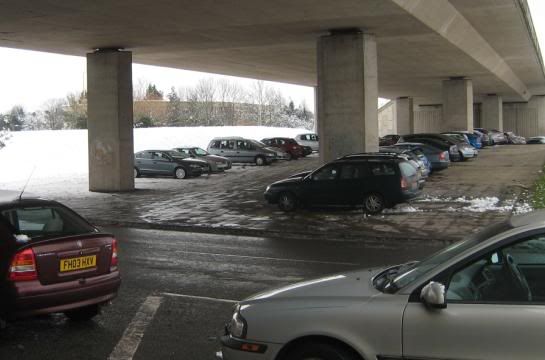
This is the London Road A3290 roundabout, full of parked cars.
In response to the emerging situation during the course of the late afternoon of 21 December 2009, when the extent and severity of the conditions and their implications across the town were anticipated, officers instigated the Emergency Plan and operations centre and put in place a range of measures from 5.30pm throughout the night.
Tuesday 22 December 2009 weather forecast was for continuing freezing conditions but no further snow fall. People coming into the town centre faced very icy conditions. Staff from parks, streetcare and highways were brought in to hand (with shovels) grit the town centre. Police and Council staff were co-ordinated and targeted blocked roads where abandoned vehicles were cleared and the roads reopened. By the afternoon most bus services were able to run on a limited basis. Most bus services were able to run but not all routes could be served until towards the end of the day. The availability of grit became an issue and highways reserved all their supplies for the primary and secondary roads network.
Members of the public across the town made a significant contribution to the clearing of snow and providing support to those in greatest need through their own, largely self-directed, local activities.
The Emergency Centre was formally established at 5.30pm on Monday the 21 December 2009 and was staffed by designated officers from services across the Council. This centre was staffed until 2.00am on Tuesday 22nd and dealt with calls from the public, liaison with the police, highways agency, neighbouring authorities and local media. The centre was able to continually monitor the traffic conditions on the roads using the traffic cameras already in place.
The Chief Executive, with representatives of West Berkshire and Wokingham in contact by phone, attended the police silver command meetings that were held at 6.30, 7.30 and 9pm on 21 December 2009, to coordinate responses and procedures throughout the affected Thames Valley area.
Several centres were set up to provide overnight accommodation for those stranded in the centre by the weather. Where more vulnerable people required assistance a number of 4x4 vehicles were used to transport people safely to their homes.
Before the emergency centre was closed a discussion and plan of action for the ongoing conditions needing to be addressed on Tuesday 22nd December was held. The Emergency Operations Centre was initiated again on the afternoon of 5 January 2010 when the forecast of severe weather was received. It has remained operational, with a rolling shift of relevant officers, throughout the period of the poor conditions and into the ‘recovery phase’, as services began to resume normal operations.
As with all other authorities our policies do not cover footways outside the pedestrianised town centre area. This is standard practice for two reasons, logistics and costs. Gritting of footways can only be done manually and is both time and resource intensive: even deploying most highways, street care and parks staff it would still take up to a week to grit all the footways in Reading and the costs would be significant. Some work is being carried out on the costs and targeting of additional gritting and this will be included in later reports. Some other highly-used pedestrian routes were gritted during this exceptional period, such as Caversham and Reading Bridges. We also had the use of a “mini digger” for the Duke Street scheme which proved very useful for clearing pedestrian routes in and around the town centre.
The provision and location of grit bins were an issue during this period. Grit bins had been relocated during the autumn as a result of the policy review with bins on gritting routes being removed as they were no longer needed and new bins located in areas where a need had been established. Unfortunately although the grit is provided for the public highway it is not always retained for this use and the ongoing cost of providing and replenishing the bins is significant.
The supply of grit/salt/urea held by the highways section is only for use when carrying out the Council’s statutory duty of maintaining the public highway. Supplies are always limited by availability and cost.
It is a great shame that all the authorities efforts were focused on getting the roads fixed, it was easier to drive from one end of the country to the other than for a pensioner with no car to walk to the shops. There seems to be no interest in gritting footpaths, even ones by shops. Clearly to have every footpath in towns cleared by people with shovels is a huge task. Perhaps we need some cycle powered gritters. This tractor powered gritter looks small enough.

In the meantime I would add to the priorities the paths near all shops. Among others many elderly and disabled people would have a read problem during this period. Some people shovelled snow from the road onto the footpath!
The council didn't seem interested in looking at gritting stocks. Gordon Brown said grit stocks for a winter 'the recommendation of six days supply was "best practice" decided by experts', but this must be increased.
The local bloggers responses on the 21st December varied enormously. The Tories Cllr Willis said 'It seems that the snow caught our local highways team on the hop as there was no obvious gritting or salting on even the main roads.' And afterwards 'What we need now is a considered investigation into the circumstances leading to yesterday’s severe weather and the Council’s reaction.' Reading East MP Rob Wilson was critical, but Wokingham's John Redwood called the reponse to the extreme conditions 'pathetic'.
The LD did point to some problems, such as buses not running. They were very quick to blame the council. They printed twitters from angry residents. Not a word about the exceptional conditions, or how council employees were working hard. And they want grit bins to be used by residents 'the Council should look to put in place facilities to enable residents to help themselves during snowy and icy weather. i.e more grit bins'
On BBC Radio Berks LD Cllr Pru Bray "heard Martin Salter (Labour MP) praise Reading council (Labour) for its efforts (and the rest of the public services) whilst this morning Rob Wilson (Tory MP) attacked it for not doing enough. Funny that."
Labours Cllr Enis refers to the public stealing grit! And 'media stories about the threat of being sued if someone were to fall on the path that was cleared of snow by a resident.'
Meanwhile Howard Thomas offers some 'common sense' opinion that it is "nothing short of a disgrace that our council are either incapable or unwilling to do their duty."
Very high numbers of people in the town centre Christmas shopping. When the severity of the weather became apparent most tried to leave during a very short space of time, resulting in queues to get out of all town centre car parks and extraordinarily high volumes of traffic on the town’s highway network. Retailers receiving information about the weather and sending staff home, adding to the sudden influx of cars onto the network from the car parks and traffic diverting from other networks.
Other roads (outside the borough such as the M40) and bridges across the Thames (such as Sonning Bridge) were closed or only open to restricted traffic resulting in significant diversion onto Reading’s roads and bridges. Conditions deteriorated very rapidly and traffic came to a standstill on most roads trapping the gritting lorries within the congestion and preventing them completing their gritting runs.
Significant numbers of people were “trapped” in vehicles and stationary for significant times. Many people managed to get to friends relatives or colleagues and spend the night there and in most of these situations vehicles were “left” in accessible places and returned to the following day.
By midnight most traffic had moved on or parked up for the night. However a significant amount of vehicles were abandoned in circumstances that led to roads being blocked. At 5am there were approximately 267 vehicles abandoned on the A33 between Vastern Road and Bennet Road with many other vehicles also abandoned throughout the Reading highway network.

This is the London Road A3290 roundabout, full of parked cars.
In response to the emerging situation during the course of the late afternoon of 21 December 2009, when the extent and severity of the conditions and their implications across the town were anticipated, officers instigated the Emergency Plan and operations centre and put in place a range of measures from 5.30pm throughout the night.
Tuesday 22 December 2009 weather forecast was for continuing freezing conditions but no further snow fall. People coming into the town centre faced very icy conditions. Staff from parks, streetcare and highways were brought in to hand (with shovels) grit the town centre. Police and Council staff were co-ordinated and targeted blocked roads where abandoned vehicles were cleared and the roads reopened. By the afternoon most bus services were able to run on a limited basis. Most bus services were able to run but not all routes could be served until towards the end of the day. The availability of grit became an issue and highways reserved all their supplies for the primary and secondary roads network.
Members of the public across the town made a significant contribution to the clearing of snow and providing support to those in greatest need through their own, largely self-directed, local activities.
The Emergency Centre was formally established at 5.30pm on Monday the 21 December 2009 and was staffed by designated officers from services across the Council. This centre was staffed until 2.00am on Tuesday 22nd and dealt with calls from the public, liaison with the police, highways agency, neighbouring authorities and local media. The centre was able to continually monitor the traffic conditions on the roads using the traffic cameras already in place.
The Chief Executive, with representatives of West Berkshire and Wokingham in contact by phone, attended the police silver command meetings that were held at 6.30, 7.30 and 9pm on 21 December 2009, to coordinate responses and procedures throughout the affected Thames Valley area.
Several centres were set up to provide overnight accommodation for those stranded in the centre by the weather. Where more vulnerable people required assistance a number of 4x4 vehicles were used to transport people safely to their homes.
Before the emergency centre was closed a discussion and plan of action for the ongoing conditions needing to be addressed on Tuesday 22nd December was held. The Emergency Operations Centre was initiated again on the afternoon of 5 January 2010 when the forecast of severe weather was received. It has remained operational, with a rolling shift of relevant officers, throughout the period of the poor conditions and into the ‘recovery phase’, as services began to resume normal operations.
As with all other authorities our policies do not cover footways outside the pedestrianised town centre area. This is standard practice for two reasons, logistics and costs. Gritting of footways can only be done manually and is both time and resource intensive: even deploying most highways, street care and parks staff it would still take up to a week to grit all the footways in Reading and the costs would be significant. Some work is being carried out on the costs and targeting of additional gritting and this will be included in later reports. Some other highly-used pedestrian routes were gritted during this exceptional period, such as Caversham and Reading Bridges. We also had the use of a “mini digger” for the Duke Street scheme which proved very useful for clearing pedestrian routes in and around the town centre.
The provision and location of grit bins were an issue during this period. Grit bins had been relocated during the autumn as a result of the policy review with bins on gritting routes being removed as they were no longer needed and new bins located in areas where a need had been established. Unfortunately although the grit is provided for the public highway it is not always retained for this use and the ongoing cost of providing and replenishing the bins is significant.
The supply of grit/salt/urea held by the highways section is only for use when carrying out the Council’s statutory duty of maintaining the public highway. Supplies are always limited by availability and cost.
It is a great shame that all the authorities efforts were focused on getting the roads fixed, it was easier to drive from one end of the country to the other than for a pensioner with no car to walk to the shops. There seems to be no interest in gritting footpaths, even ones by shops. Clearly to have every footpath in towns cleared by people with shovels is a huge task. Perhaps we need some cycle powered gritters. This tractor powered gritter looks small enough.

In the meantime I would add to the priorities the paths near all shops. Among others many elderly and disabled people would have a read problem during this period. Some people shovelled snow from the road onto the footpath!
The council didn't seem interested in looking at gritting stocks. Gordon Brown said grit stocks for a winter 'the recommendation of six days supply was "best practice" decided by experts', but this must be increased.
The local bloggers responses on the 21st December varied enormously. The Tories Cllr Willis said 'It seems that the snow caught our local highways team on the hop as there was no obvious gritting or salting on even the main roads.' And afterwards 'What we need now is a considered investigation into the circumstances leading to yesterday’s severe weather and the Council’s reaction.' Reading East MP Rob Wilson was critical, but Wokingham's John Redwood called the reponse to the extreme conditions 'pathetic'.
The LD did point to some problems, such as buses not running. They were very quick to blame the council. They printed twitters from angry residents. Not a word about the exceptional conditions, or how council employees were working hard. And they want grit bins to be used by residents 'the Council should look to put in place facilities to enable residents to help themselves during snowy and icy weather. i.e more grit bins'
On BBC Radio Berks LD Cllr Pru Bray "heard Martin Salter (Labour MP) praise Reading council (Labour) for its efforts (and the rest of the public services) whilst this morning Rob Wilson (Tory MP) attacked it for not doing enough. Funny that."
Labours Cllr Enis refers to the public stealing grit! And 'media stories about the threat of being sued if someone were to fall on the path that was cleared of snow by a resident.'
Meanwhile Howard Thomas offers some 'common sense' opinion that it is "nothing short of a disgrace that our council are either incapable or unwilling to do their duty."
Friday, 22 January 2010
Cash4Gold rip off
The price of gold has reached new records over the past few months, and so companies that exchange people's gold for cash have grown in popularity. People have been comparing prices for unwanted gold jewellery from high street and freepost schemes.
So how did Cash4Gold compare with some items valued at £300? The firm sent a cheque for just £63. When they called to ask for the jewellery back that offer was increased to £100.
The firm's boss, Jeff Aronson, makes no apologies for pricing, claiming that some people are willing to accept less for their gold in return for convenience and speed. "Our customers are not interested in going to a pawnshop or a jewellery store." "They would be mortified if a friend saw them doing that. We are serving a new industry that we have created. We are not here to price fight against a jeweller."
Crewe-based CashMyGold is the most high profile British company in the market. Like its American namesake it spends heavily on advertising, especially on daytime TV. It works in an identical way: users call or go online, order an envelope, post off their gold and wait for the cheque to arrive. CashMyGold uses the slogan "best prices paid for your gold" but its offer was the lowest of the three at just £60.20. When questioned a sales rep immediately offered to increase the offer to "£150 maximum". In a statement the firm said it has a "very different business model" to high street gold dealers with "different costs such as postal insurance and administration" to consider. "Taking this into account, we believe we offer a fair price for those who are looking for a hassle free, door-to-door service," it said.
Finally high street jeweller H.Samuel launched its own postal gold service over the summer.
Unlike other firms, it always telephones customers to ask if they will accept an offer rather than sending a cheque straight back. Its quote? The highest of the three at £182 rising to £210 if gift vouchers instead of a cheque, still significantly below the £300 quoted by a gold bullion dealer. Again the firm claimed its offers are fair. "By using our service customers are dealing with a well-known and established high street jeweller with national store coverage," it said. "If the customer does not want to accept our offer the jewellery is returned at no cost to them."
The findings to the Trading Standards Institute. Its joint lead officer for fair trading, Alonso Ercilla, said offering a low price for gold might be irritating but it's not illegal. "Unfortunately there isn't much Trading Standards can do if people are getting a bad deal, provided the trader is not actually misleading the seller about the gold's worth," he said.
"Customers need to shop around and try to establish the price per gram. "If you are using a website, read their terms and conditions. And don't automatically take the first price you are offered."
The Office of Fair Trading (OFT) has launched an investigation into companies that offer cash for gold jewellery by post. The OFT is also asking to hear, via its website, about consumers' experiences of using these firms.
CashMyGold, PostGoldForCash, Pawnbroker Ramsden’s Got Gold Get Cash are thought to be under the spotlight. The US-based Cash4Gold, which was launched in the UK in July, could also be subject to investigation.
The price of gold has soared since the collapse in September 2008 of Lehman Brothers, the investment bank. In December it peaked above $1,200 and remains about $1,100 an ounce.
So how did Cash4Gold compare with some items valued at £300? The firm sent a cheque for just £63. When they called to ask for the jewellery back that offer was increased to £100.
The firm's boss, Jeff Aronson, makes no apologies for pricing, claiming that some people are willing to accept less for their gold in return for convenience and speed. "Our customers are not interested in going to a pawnshop or a jewellery store." "They would be mortified if a friend saw them doing that. We are serving a new industry that we have created. We are not here to price fight against a jeweller."
Crewe-based CashMyGold is the most high profile British company in the market. Like its American namesake it spends heavily on advertising, especially on daytime TV. It works in an identical way: users call or go online, order an envelope, post off their gold and wait for the cheque to arrive. CashMyGold uses the slogan "best prices paid for your gold" but its offer was the lowest of the three at just £60.20. When questioned a sales rep immediately offered to increase the offer to "£150 maximum". In a statement the firm said it has a "very different business model" to high street gold dealers with "different costs such as postal insurance and administration" to consider. "Taking this into account, we believe we offer a fair price for those who are looking for a hassle free, door-to-door service," it said.
Finally high street jeweller H.Samuel launched its own postal gold service over the summer.
Unlike other firms, it always telephones customers to ask if they will accept an offer rather than sending a cheque straight back. Its quote? The highest of the three at £182 rising to £210 if gift vouchers instead of a cheque, still significantly below the £300 quoted by a gold bullion dealer. Again the firm claimed its offers are fair. "By using our service customers are dealing with a well-known and established high street jeweller with national store coverage," it said. "If the customer does not want to accept our offer the jewellery is returned at no cost to them."
The findings to the Trading Standards Institute. Its joint lead officer for fair trading, Alonso Ercilla, said offering a low price for gold might be irritating but it's not illegal. "Unfortunately there isn't much Trading Standards can do if people are getting a bad deal, provided the trader is not actually misleading the seller about the gold's worth," he said.
"Customers need to shop around and try to establish the price per gram. "If you are using a website, read their terms and conditions. And don't automatically take the first price you are offered."
The Office of Fair Trading (OFT) has launched an investigation into companies that offer cash for gold jewellery by post. The OFT is also asking to hear, via its website, about consumers' experiences of using these firms.
CashMyGold, PostGoldForCash, Pawnbroker Ramsden’s Got Gold Get Cash are thought to be under the spotlight. The US-based Cash4Gold, which was launched in the UK in July, could also be subject to investigation.
The price of gold has soared since the collapse in September 2008 of Lehman Brothers, the investment bank. In December it peaked above $1,200 and remains about $1,100 an ounce.
Wednesday, 20 January 2010
Chocolate Wars
So Cadbury will be a owned by Craft, another icon bites the dust. Not so long ago the much admired Green and Blacks became owned by Cadbury, a certain irony there.
When George Cadbury decided some 150 years ago to combine the business of making chocolate with his Quaker principles of quiet philanthropy, the result was the famous Bournville village which provided high-quality housing at a low-cost to his employees. As he put it: "No one should live where a rose cannot grow."
Baron Mandelson last week attempted to wrap himself in the flag of corporate patriotism by warning that any foreign buyer of Cadbury would have to "respect our company, respect our workforce and respect the legacy of our company". Asked about the merits of the US conglomerate, Kraft, the world's second largest food producer and the maker of products from Oreo biscuits to Philadelphia cheese, announced its intentions in September. Felicity Loudon, the great-granddaughter of Mr Cadbury and a remaining shareholder said: "I identify them with plastic cheese on hamburgers." "My fear is this will all become history and it will be too late. I think the predators are circling. It's desperately sad that yet another British icon could go abroad." Both Rowntree and Frys were acquired by foreign competitors who pledged autonomy for the British firms, only to eventually consign them to history. The Rowntree name was abolished last year and Fry's, owned by Kraft, closed its York factory in 2004.
The Cadbury years (its a bit like Déjà vu)
1900 Bournville Village is handed over to an independent trust by the Cadbury company.
1969 Cadbury merges with Schweppes, ending ownership by the Cadbury family.
2007 Cadbury announces closure of its Somerset factory, transferring production to Poland with the loss of 500 jobs.
Here is a chart of who owns what in the world of chocolate.
But what interests me is the Chocolate War in the late 1990s, which forced manufacturers to state the percentage of Cacao.
In 1994 the European Union was establishing Europe-wide food standards. When they came around to Chocolate, Belgium and France and Germany supported the idea of creating a standard that said only something that was in excess of 50% Cacao could be called Chocolate. England (home of Cadbury which manufactures tons of candy that contains less than 10% Cacao) opposed the idea.
Unsweetened or bitter chocolate contains nearly 100 percent cocoa mass. Semisweet and bittersweet chocolates have added sugar, so their cocoa percentages are a little lower - good quality dark chocolate usually contains a minimum of 50 percent cocoa mass, but can go as high as 85 percent. Because milk chocolate has more added sugar than dark, as well as dried milk solids, it has a lower percentage of cocoa mass, usually about 30 to 40 percent.
Some say say that darker chocolate is better for you. Others say that the numbers dont always tell you which is better.
At first the pro-Chocolate forces looked likely to win. After months of arguments and threatened trade wars, Germany switched sides. So England, and Cadbury won. Anything can be called Chocolate in the EU, as long as it contains at least 1% Chocolate. (In the USA the FDA minimum is 10%.) However -- the EU said that each bar must state on the label the percentage of Cacao that it contains.
That last bit was crucial, and the reaction was predictable. Consumers went to the few bars that were rich & pure, 70% or more. So the milk-chocolate-candy prints the percentages in teeny tiny print on the back, and the pure bars print it in huge print on the front. Even Cadbury has one (in late 1997 they raised the Cacao content from 64% to 76%), called 1898 -- but they do not put their own name anywhere on it, for fear of hurting sales!
In the United States, chocolate manufacturers are not required to declare the percentage of cacao in their chocolate products. However, in typical capitalism fashion, as more Americans become educated about quality chocolate and have sought out fine imported varieties that bear the designation, many producers have been listing "% Cacao" or "% Cocoa." Some have also brought out their own lines of cacao-rich chocolate products.
When George Cadbury decided some 150 years ago to combine the business of making chocolate with his Quaker principles of quiet philanthropy, the result was the famous Bournville village which provided high-quality housing at a low-cost to his employees. As he put it: "No one should live where a rose cannot grow."
Baron Mandelson last week attempted to wrap himself in the flag of corporate patriotism by warning that any foreign buyer of Cadbury would have to "respect our company, respect our workforce and respect the legacy of our company". Asked about the merits of the US conglomerate, Kraft, the world's second largest food producer and the maker of products from Oreo biscuits to Philadelphia cheese, announced its intentions in September. Felicity Loudon, the great-granddaughter of Mr Cadbury and a remaining shareholder said: "I identify them with plastic cheese on hamburgers." "My fear is this will all become history and it will be too late. I think the predators are circling. It's desperately sad that yet another British icon could go abroad." Both Rowntree and Frys were acquired by foreign competitors who pledged autonomy for the British firms, only to eventually consign them to history. The Rowntree name was abolished last year and Fry's, owned by Kraft, closed its York factory in 2004.
The Cadbury years (its a bit like Déjà vu)
1900 Bournville Village is handed over to an independent trust by the Cadbury company.
1969 Cadbury merges with Schweppes, ending ownership by the Cadbury family.
2007 Cadbury announces closure of its Somerset factory, transferring production to Poland with the loss of 500 jobs.
Here is a chart of who owns what in the world of chocolate.
But what interests me is the Chocolate War in the late 1990s, which forced manufacturers to state the percentage of Cacao.
In 1994 the European Union was establishing Europe-wide food standards. When they came around to Chocolate, Belgium and France and Germany supported the idea of creating a standard that said only something that was in excess of 50% Cacao could be called Chocolate. England (home of Cadbury which manufactures tons of candy that contains less than 10% Cacao) opposed the idea.
Unsweetened or bitter chocolate contains nearly 100 percent cocoa mass. Semisweet and bittersweet chocolates have added sugar, so their cocoa percentages are a little lower - good quality dark chocolate usually contains a minimum of 50 percent cocoa mass, but can go as high as 85 percent. Because milk chocolate has more added sugar than dark, as well as dried milk solids, it has a lower percentage of cocoa mass, usually about 30 to 40 percent.
Some say say that darker chocolate is better for you. Others say that the numbers dont always tell you which is better.
At first the pro-Chocolate forces looked likely to win. After months of arguments and threatened trade wars, Germany switched sides. So England, and Cadbury won. Anything can be called Chocolate in the EU, as long as it contains at least 1% Chocolate. (In the USA the FDA minimum is 10%.) However -- the EU said that each bar must state on the label the percentage of Cacao that it contains.
That last bit was crucial, and the reaction was predictable. Consumers went to the few bars that were rich & pure, 70% or more. So the milk-chocolate-candy prints the percentages in teeny tiny print on the back, and the pure bars print it in huge print on the front. Even Cadbury has one (in late 1997 they raised the Cacao content from 64% to 76%), called 1898 -- but they do not put their own name anywhere on it, for fear of hurting sales!
In the United States, chocolate manufacturers are not required to declare the percentage of cacao in their chocolate products. However, in typical capitalism fashion, as more Americans become educated about quality chocolate and have sought out fine imported varieties that bear the designation, many producers have been listing "% Cacao" or "% Cocoa." Some have also brought out their own lines of cacao-rich chocolate products.
Peter Tatchell is Liberal Voice of the Year
What a surprise, a Green wins the vote by Liberal Democrat Voice readers. Peter Tatchell has won Liberal Democrat Voice's third annual Liberal Voice of the Year award for his tireless and fearless international human rights campaigning.
Here he is pictured after attempting to arrest Mugabe. The beating by Mugabe's thugs has helped cause Peter to step down as Oxford East Parliamentary candidate.
The runner-up was author and journalist Ben Goldacre. Other contenders were Joanna Lumley, Rory Stewart, Terry Pratchett, Henry Porter, Guy Herbert and Alan Rushbridger.
The two previous years Liberal Voice winners were Shami Chakrabati(2007), and the campaigners on behalf of Jean Charles de Menezes (Justice4Jean.org) and the Stockwell Shooting Inquest Jury (2008).
See the Liberal Democrat Voice report about the online readers poll result here.
Responding to winning the vote, Peter Tatchell said:
www.petertatchell.net
Last month Peter stepped down saying:
I think Peter should get a medal for his bravery, and be made a peer. And why not a peerage for the other winners such as Shami Chakrabati also.
Here he is pictured after attempting to arrest Mugabe. The beating by Mugabe's thugs has helped cause Peter to step down as Oxford East Parliamentary candidate. The runner-up was author and journalist Ben Goldacre. Other contenders were Joanna Lumley, Rory Stewart, Terry Pratchett, Henry Porter, Guy Herbert and Alan Rushbridger.
The two previous years Liberal Voice winners were Shami Chakrabati(2007), and the campaigners on behalf of Jean Charles de Menezes (Justice4Jean.org) and the Stockwell Shooting Inquest Jury (2008).
See the Liberal Democrat Voice report about the online readers poll result here.
Responding to winning the vote, Peter Tatchell said:
"Wow! What an honour. I’m chuffed. Thanks to everyone who voted for me.
"I am honoured, but quite surprised, to win Liberal Voice of the Year, given that I'm a left-wing Green. It shows that Liberal Democrat Voice readers are non-sectarian and inclusive, putting values and principles above narrow party interests, which is how it should be. There are progressive people in all parties, apart from the BNP and possibly UKIP. We should work together more, focusing on what we have in common rather than on what divides us. In Britain, the combined supporters of liberal, green and left values constitute the majority. If people from these three political strands cooperated more closely, and if we had had a fair voting system, Britain need never again suffer a Conservative government. We could move the country forward on a progressive agenda for social justice, democratic reform, civil liberties and environmental renewal.
At the international level, it has been a real privilege to write and campaign in support of the freedom struggles in Iran, Russia, Balochistan, Uganda, Iraq, Somaliland, West Papua, Sudan, Palestine and Saudi Arabia. The democracy activists in these countries are truly heroic and inspirational. I crawl in their shadows.
One of the things I have learned from my 43 years of human rights campaigning is that no matter how small and weak we may feel, we can all help make a difference. I do my bit for human rights, as do millions of others. Together, cumulatively and collectively, slowly but surely, we are shaping a better world."
www.petertatchell.net
Last month Peter stepped down saying:
“It is with great regret and reluctance that I am standing down as the Green Party parliamentary candidate for Oxford East. My brain injuries from the Mugabe and Moscow bashings mean that I would not be able to campaign effectively in the general election or do the duties required of an MP, if I was elected,”
“It would not be right for me to seek election if I could not do the job of an MP to the high standards that I want and that Oxford East voters have a right to expect.
“If I was elected, I could manage the parliamentary duties or the constituency work. But my health is not strong enough for me to do both.
“This is a huge disappointment and frustration. Oxford East is a target Green seat. In the county elections in June, the Greens were neck-and-neck with the Liberal Democrats as the main challenger to Labour. The European elections saw the Greens win in Oxford East, well ahead of Labour, the Lib Dems and the Tories.
“The injuries don’t stop me from campaigning but I am slower, make more mistakes, get tired easily and take longer to do things. My memory, concentration, balance and coordination have been adversely affected. I can’t campaign at the pace I used to.
“I was selected as the Green Party candidate for Oxford East in April 2007. A month later, I was badly beaten around the head by neo-Nazis during an attempted Gay Pride parade in Moscow.
See here:
“This exacerbated the brain damage caused when I was bashed unconscious by President Mugabe’s bodyguards in Brussels in 2001, after attempting to make a citizen’s arrest of the Zimbabwean leader on charges of torture.
See http://www.petertatchell.net/international/mugabearrest.htm:
I think Peter should get a medal for his bravery, and be made a peer. And why not a peerage for the other winners such as Shami Chakrabati also.
Monday, 18 January 2010
Why Climate Change Can Mean A Colder UK

The Gulf Stream currents that give Britain its mild climate have weakened dramatically, offering scientific evidence of a slowdown that threatens the country with temperatures as cold as Canada’s.
Scientists have long predicted that melting ice caps could disrupt the currents that keep Britain at least 5C (40F) warmer than it should be, but the new research suggests that this is already under way. It points to a cooling of 1C over the next decade or two, and an even deeper freeze could follow if the Gulf Stream system were to shut down altogether.
The British Isles lie on the same latitude as Labrador on the East Coast of Canada, and are protected from a similarly icy climate by the Atlantic conveyor belt, which carries a million billion watts of heat. Although oceanographers still think it unlikely that the currents will stop completely, this could reduce average temperatures by between 4C and 6C in as little as 20 years, far outweighing any increase predicted as a result of global warming.
Even a lesser fall in temperatures could mean that Britain gets colder even as the rest of the world warms up, and would severely disrupt the Government’s plans for mitigating the effects of climate change.
Global warming is predicted to disrupt this process, as extra freshwater from melting ice caps reduces the salinity of the Arctic waters, stopping it from sinking and breaking the circuit. The Southampton team measured current flow across a latitude of 250N. The original Gulf Stream, cold water returning from the Arctic, and the southern branch of warm water all cross this line stretching from North Africa to the Bahamas.
The results, published in Nature, show that the strength of the cold water returning from the Arctic has fallen by 30 per cent since 1992. Over the same period, the flow of warm water branching off towards Africa has increased by 30 per cent. This suggests that the warm waters are being diverted away from Europe.
An armada of robot submarines and marine sensors are to be deployed across the Atlantic, from Florida to the Canary Islands, to provide early warning that the Gulf Stream might be failing, an event that would trigger cataclysmic freezing in Britain for decades. The £16m system, called Rapid Watch, will use the latest underwater monitoring techniques to check whether cold water pouring south from melting Arctic ice sheets is diverting the current's warm waters away from Britain.
'The Day After Tomorrow suggested the Gulf Stream could fail within a couple of days,' said Rapid Watch's co-ordinator, Meric Srokosz of the National Oceanography Centre, Southampton (NOCS). 'In reality, a collapse will take a lot longer, but could still occur in about 10 years.' Rapid Watch has been designed to discover if such weakening is already occurring or is about to begin.
East Berks GP
science daily
Woods Hole Oceanographic Inst
Sunday, 17 January 2010
Eco School Petition

The government should enable all Schools in the UK to install renewable energy technologies (such as wind turbines, solar panels and geothermal) to educate the next generation on sustainability.
Renewable energy technologies can be used as an educational tool in science lessons, whilst generating a useful output of energy for the school. In the right location renewable energy can be an economic opportunity and reduce the school's energy bills. It also reduces carbon dioxide emissions for years to come. Schools currently do not have the capacity to invest in renewable energy and there are barriers such as planning permission.
To support renewable energy the government could, for example, provide interest-free loans that can be paid back by the savings made. The government should set the target of installing renewable energy in all UK schools as a priority; to enable a sustainable future for current and future generations.
Sign a petition here
Saturday, 16 January 2010
Mark Thomas 'The Manifesto' comes to Reading Friday 22 January 2010 at 8pm
Award-winning comedian and activist Mark Thomas returns to South Street Arts Centre to deliver a progress report on his year of campaigning on the laws his audiences voted for in their "Manifesto". It will be at South Street on Friday 22 January 2010 at 8pm
Every show is unique and new material is added every performance. Mark creates a manifesto - a policy paddle to help steer our way out of the utter financial mess we're in. Every audience gets to vote on the policies they like, Mark road tests them and then sets off to make them happen. It is somewhere between 'Jim'll Fix It for anarchists' and White
Collar Crimewatch, with a passing nod at Bill Drummond, the Fluxus art movement and Anneka Rice.
So far, policies voted through include introducing a national maximum wage, getting the government to give everyone the day off on their birthday, legalising homosexual marriage and getting the church to shut up about it, a three-day weekend, land instead of the dole, IRA honour guard for Thatcher's funeral, no new blasphemy legislation (or anyone who can see the Virgin Mary in a tree stump should be sued under it) and the introduction of the prohibition of deception law, making it illegal for MPs to knowingly lie. It shall be known as ‘Archer's law’.
Policies chosen so far are;
- All politicians should be forced to wear the names and logos of the companies which sponsor them
- Anyone who supports ID cards should be banned from having curtains
- The introduction of a law making it illegal for MPs to knowingly lie. It shall be known as Archer’s Law
- All models should be picked at random from the electoral register
The People’s Manifesto will outline 50 policies of the manifesto shouted out in bold type on a page to themselves with Mark's commentary opposite. Mark has even ‘road tested' some of them - like hosting a party in an MP’s second home (which clearly belongs to the taxpayer) and getting university boffins to work out a way of SAT testing MPs to rank them by value.
After 23 years of performing, six series of the Mark Thomas Product and Mark Thomas Comedy Product with Channel 4, numerous documentaries, two books, radio programmes, changing the law on tax, secretly filming torturers, stinging arms dealers with school children, exposing abuses of civil liberties and corporate skulduggery. He also has in the ast backed the Green Party.
www.markthomasinfo.com
Tickets £15, Concessions £10 Subject to booking fee
Every show is unique and new material is added every performance. Mark creates a manifesto - a policy paddle to help steer our way out of the utter financial mess we're in. Every audience gets to vote on the policies they like, Mark road tests them and then sets off to make them happen. It is somewhere between 'Jim'll Fix It for anarchists' and White
Collar Crimewatch, with a passing nod at Bill Drummond, the Fluxus art movement and Anneka Rice.
So far, policies voted through include introducing a national maximum wage, getting the government to give everyone the day off on their birthday, legalising homosexual marriage and getting the church to shut up about it, a three-day weekend, land instead of the dole, IRA honour guard for Thatcher's funeral, no new blasphemy legislation (or anyone who can see the Virgin Mary in a tree stump should be sued under it) and the introduction of the prohibition of deception law, making it illegal for MPs to knowingly lie. It shall be known as ‘Archer's law’.
Policies chosen so far are;
- All politicians should be forced to wear the names and logos of the companies which sponsor them
- Anyone who supports ID cards should be banned from having curtains
- The introduction of a law making it illegal for MPs to knowingly lie. It shall be known as Archer’s Law
- All models should be picked at random from the electoral register
The People’s Manifesto will outline 50 policies of the manifesto shouted out in bold type on a page to themselves with Mark's commentary opposite. Mark has even ‘road tested' some of them - like hosting a party in an MP’s second home (which clearly belongs to the taxpayer) and getting university boffins to work out a way of SAT testing MPs to rank them by value.
After 23 years of performing, six series of the Mark Thomas Product and Mark Thomas Comedy Product with Channel 4, numerous documentaries, two books, radio programmes, changing the law on tax, secretly filming torturers, stinging arms dealers with school children, exposing abuses of civil liberties and corporate skulduggery. He also has in the ast backed the Green Party.
www.markthomasinfo.com
Tickets £15, Concessions £10 Subject to booking fee
Gordon Brown: Fights For The Rights Of The Middle Class
Gordon Brown said that Labour would have to cut public spending but said the way out of recession was to "unleash a wave of social mobility" not seen in this country for more than six decades.
The last 12 years have seen a reduction in social mobility. What have they being doing all this time? And who is going to believe that they are going to be any different in future.
He also said "Opportunity and reward cannot be hoarded at the top and it is not enough to protect people at the bottom." Thats telling them. So ignore those at the bottom, in a desperate attempt to court the better off voters.
The prime minister said Labour would create "more middle class jobs than ever before". Mr Brown added that in the next decade, only 10% of jobs will be unskilled - the "biggest number of middle class jobs in our history". He said he would achieve this through education and that a target would be set of 75% of people aged under 30 to have access to either university or technical college.
If we can't afford to have 50% students now, where is the money coming from for 75%? And what about the people who want to learn something more practical, will there be no need for plumbers/electricians/carpenters/mechanics etc? What happened to those green jobs in insulating buildings, building renewable sources of energy. Planning like that is why we have needed so many skilled people from other countries. Maybe he needs an education.
Could this be a cynical attempt to go for the majority of voters? Trying to out Tory the Tories will never work, he is no Blair, and we all stopped believing Blair anyway.
The last 12 years have seen a reduction in social mobility. What have they being doing all this time? And who is going to believe that they are going to be any different in future.
He also said "Opportunity and reward cannot be hoarded at the top and it is not enough to protect people at the bottom." Thats telling them. So ignore those at the bottom, in a desperate attempt to court the better off voters.
The prime minister said Labour would create "more middle class jobs than ever before". Mr Brown added that in the next decade, only 10% of jobs will be unskilled - the "biggest number of middle class jobs in our history". He said he would achieve this through education and that a target would be set of 75% of people aged under 30 to have access to either university or technical college.
If we can't afford to have 50% students now, where is the money coming from for 75%? And what about the people who want to learn something more practical, will there be no need for plumbers/electricians/carpenters/mechanics etc? What happened to those green jobs in insulating buildings, building renewable sources of energy. Planning like that is why we have needed so many skilled people from other countries. Maybe he needs an education.
In February 2009, the Economist magazine announced that over half the world's population now belongs to the middle class, as a result of rapid growth in emerging countries. It characterized the middle class as having a reasonable amount of discretionary income, so that they do not live from hand to mouth as the poor do. This allows people to buy consumer goods, improve their health care, and provide for their children’s education.Clearly they need help, Gordon to the rescue.
Could this be a cynical attempt to go for the majority of voters? Trying to out Tory the Tories will never work, he is no Blair, and we all stopped believing Blair anyway.
Council Grants Cut While Charges Increase
The total that Reading Borough Council (RBC) spends on supporting the voluntary sector has fallen for the first time in years, from £2,665,962 last year to a planned £2,605,298 this year. Almost all new applications have been refused and some groups have seen a cut in longstanding funding.
The majority of the organisations which get ongoing funding asked for more this year, but nearly all had to settle for the same amount they got last year or slightly less. So in real terms its cut cut cut.
- Churches in Reading Drop-in Centre gets a provisional £10,548, but is on a 'warning' "Payments will not be released until some measurable progress has been made."
- Reading YMCA got help worth £2,618 last year and asked for £50,000 this year, but had its grant request refused.
Meanwhile RBC will be looking at tough choices to save cash including cutting 165 posts over the next five years. The need to save has been brought about by the reduction in Government grant to the council over the last three years. It was reduced 2.5 per cent in 2008/9, by a further two per cent in 2009/10 and by another 1.5 per cent in the coming year.
But residents will have noticed their Council taxes going up. This years overall percentage increase is 4.1%
The majority of the organisations which get ongoing funding asked for more this year, but nearly all had to settle for the same amount they got last year or slightly less. So in real terms its cut cut cut.
- Churches in Reading Drop-in Centre gets a provisional £10,548, but is on a 'warning' "Payments will not be released until some measurable progress has been made."
- Reading YMCA got help worth £2,618 last year and asked for £50,000 this year, but had its grant request refused.
Meanwhile RBC will be looking at tough choices to save cash including cutting 165 posts over the next five years. The need to save has been brought about by the reduction in Government grant to the council over the last three years. It was reduced 2.5 per cent in 2008/9, by a further two per cent in 2009/10 and by another 1.5 per cent in the coming year.
But residents will have noticed their Council taxes going up. This years overall percentage increase is 4.1%
Friday, 15 January 2010
Political Split; Lab, Ukip, Bnp
The Labour attempted coup from Hoon and Hewitt has generated lots of headlines, and a few jokes.
Not so high up the news agenda has been a split in UKIP. Nikki Sinclair MEP decided not to sit with her fellow MEPs, after homophobic and anti-semitic statements. Nigel Farage denounced her on live TV, and claimed she had not disclosed that she had been made bankrupt in the past.
Miss Sinclaire denied this. She said that despite not facing any disciplinary procedures she had been told by party officials that she could not use its logo or name in future elections. She said UKIP's party secretary and press officers had been "fully aware" of her bankruptcy, which had "long since been discharged". "I have not been through any disciplinary procedures". "I have had no right of reply." She said Lord Pearson, who succeeded Mr Farage as leader in December, told her she would be able to remain as a UKIP representative outside the coalition and appealed to him to honour this.
A quarter of their MEPs elected in 2004 finished their mandates as non-attached members, including Roger Knapman, the former leader of his party, who resigned from the Ind Dem group in accordance with the wishes of his constituents. Ms Sinclaire had been selected to fight the Meriden seat at the next UK general election.
Meanwhile a BNP member was caught with a bomb factory in his bedroom! It seems he nearly caused a split with himself.
Over 10 years Terence Gavan, 39, stockpiled 54 improvised bombs, mostly packed with nails and ball bearings. Gavan was described as “a lone operator with an obsession with guns and explosives.” One of the bombs was a “victim-operated” booby trap concealed in a cigarette packet. In the locked attic bedroom of his mother's terraced home he stored more than 30 weapons, many of them he had constructed himself. They included a samurai sword, shot guns, pen guns and pistols and 120 rounds of ammunition and around 40 knives and a crossbow.
Not so high up the news agenda has been a split in UKIP. Nikki Sinclair MEP decided not to sit with her fellow MEPs, after homophobic and anti-semitic statements. Nigel Farage denounced her on live TV, and claimed she had not disclosed that she had been made bankrupt in the past.
Miss Sinclaire denied this. She said that despite not facing any disciplinary procedures she had been told by party officials that she could not use its logo or name in future elections. She said UKIP's party secretary and press officers had been "fully aware" of her bankruptcy, which had "long since been discharged". "I have not been through any disciplinary procedures". "I have had no right of reply." She said Lord Pearson, who succeeded Mr Farage as leader in December, told her she would be able to remain as a UKIP representative outside the coalition and appealed to him to honour this.
A quarter of their MEPs elected in 2004 finished their mandates as non-attached members, including Roger Knapman, the former leader of his party, who resigned from the Ind Dem group in accordance with the wishes of his constituents. Ms Sinclaire had been selected to fight the Meriden seat at the next UK general election.
Meanwhile a BNP member was caught with a bomb factory in his bedroom! It seems he nearly caused a split with himself.
Over 10 years Terence Gavan, 39, stockpiled 54 improvised bombs, mostly packed with nails and ball bearings. Gavan was described as “a lone operator with an obsession with guns and explosives.” One of the bombs was a “victim-operated” booby trap concealed in a cigarette packet. In the locked attic bedroom of his mother's terraced home he stored more than 30 weapons, many of them he had constructed himself. They included a samurai sword, shot guns, pen guns and pistols and 120 rounds of ammunition and around 40 knives and a crossbow.
Thursday, 14 January 2010
"ASBO for photographer who snapped grafitti"
Once again Reading has become well known for the wrong reasons. Last month it was all those abandoned cars, this time, an ASBO for photographer who snapped grafitti 'art'.
A photographer who snapped Banksy-style images has been given an ASBO last month after he was deemed a nuisance. But an impressive selection of art lovers – including a curator from the Tate Gallery in London and the authors of a heavyweight New York art book – gave references in favour of East Reading’s James Matthews. The judge dismissed a number of criminal damage counts against Matthews and instead decided he should get a two-year ASBO. Judge Reddihough, sentencing, said: “I have seen a number of examples of the graffiti. It may well be that some sort of graffiti could come into the class of a work of art.”
To be fair it seems he trespassed on roofs and railway property to take the pictures, and the ASBO related to this. There seems to be no evidence that he encouraged any damage to property.
At the Banksy forum, contributors have picked up on the headline ASBO for photographer who snapped grafitti 'art' headline.

There is a trend for people being arrested for taking pictures, I was stopped at AWE Aldermaston a couple of years ago and the police made me delete a couple of pictures from my camera. They were taken from the public road I hasten to add. I didn't want to be arrested, so I complied. But later I took a few more.
When the police stop you these days, they have to fill in a form. In order to comply with regulations they ask you for your background, so this gives some people small amount of pleasure to make up something amusing. I wonder how many of those questioned are actually Jedi. Its easier to spell than Wookiee anyway.
A photographer who snapped Banksy-style images has been given an ASBO last month after he was deemed a nuisance. But an impressive selection of art lovers – including a curator from the Tate Gallery in London and the authors of a heavyweight New York art book – gave references in favour of East Reading’s James Matthews. The judge dismissed a number of criminal damage counts against Matthews and instead decided he should get a two-year ASBO. Judge Reddihough, sentencing, said: “I have seen a number of examples of the graffiti. It may well be that some sort of graffiti could come into the class of a work of art.”
To be fair it seems he trespassed on roofs and railway property to take the pictures, and the ASBO related to this. There seems to be no evidence that he encouraged any damage to property.
At the Banksy forum, contributors have picked up on the headline ASBO for photographer who snapped grafitti 'art' headline.

There is a trend for people being arrested for taking pictures, I was stopped at AWE Aldermaston a couple of years ago and the police made me delete a couple of pictures from my camera. They were taken from the public road I hasten to add. I didn't want to be arrested, so I complied. But later I took a few more.
When the police stop you these days, they have to fill in a form. In order to comply with regulations they ask you for your background, so this gives some people small amount of pleasure to make up something amusing. I wonder how many of those questioned are actually Jedi. Its easier to spell than Wookiee anyway.
Thousands Dead In Haiti, Emergency Response
Haiti has been struck by the most powerful earthquake in 200 years, killing thousands of people and leaving many more homeless. The devastating earthquake struck the country on 12 January, approximtaely 15 km south of its densely populated capital, Port-au-Prince, bringing down the presidential palace as well as a five-story UN building and thousands of homes and public buildings.
The president of Haiti, René Préval, told international media that the mayhem and destruction caused in the aftermath of the magnitude 7.0 tremor was "un imaginable". Haiti has been brought to its knees and the country is calling for international help and support.
RedR is supporting aid agencies, who are deploying emergency teams in response and assessing the scale and impact of this disaster, on the poorest country in the Western Hemisphere.
RedR is an international charity that provides training and recruitment services for the humanitarian sector, improving emergency response worldwide. For the past 30 years, we have been helping rebuild the lives of those affected by disaster.
A major international humanitarian response is needed to support the country’s limited response force. Oxfam, Save the Children, MSF and the British Red Cross among others, have already launched emergency appeals. RedR has a number of experienced, qualified aid workers on stand-by from its active Membership of over 1700 Members, ready to fly out to contribute to relief efforts. In addition RedR Members are involved in coordinating emergency relief efforts and the charity has received requests for specialist advice into its free, on-line Technical Support Service.
RedR is conducting an initial needs assessment to identify the training requirements of aid agencies who are responding to the crisis. This needs assessment will involve not only the international community but many local and national NGOs who it is anticipated will play a major role in the response. So far information sources suggest that water and sanitation, shelter and security will be major issues. These are all key areas of RedR expertise.
As communications are disrupted, it is not yet known exactly how bad the situation is, but initial opinions suggest it could be a disaster of catastrophic proportions. Emergency shelter expert and RedR Member Joseph Ashmore, who was in Haiti just over a year ago responding to urban shelter needs following severe flooding in Gonaives, comments;
“When I was in Haiti, I was concerned about the risk of earthquake. Houses in Port-au-Prince are built high up onto the hill slide and the town is developed with limited planning and using poor construction techniques. I thought that if an earthquake were to strike, then it would be a huge disaster.”
The earthquake is just one in a long list of disasters to hit Haiti in recent years. In 2008, four deadly storms battered Haiti causing widespread flooding and fatal mudslides. Recovery from such natural disasters is also complicated by civil unrest.
Joseph fears recovery may be difficult; "There will be serious issues in the longer term requiring longer term support from organisations like RedR - long after the earthquake has faded from the news. It will be a complex urban reconstruction with multistory houses and a history of chronic poverty and unrest."
Please donate now to our Emergency Response Fund. Donations will be used to help RedR respond to the needs of the relief workers on the ground right now and in the future.
If you would like to make a donation to RedR please visit our Donate page or call 020 7840 6000.
www.redr.org.uk
The president of Haiti, René Préval, told international media that the mayhem and destruction caused in the aftermath of the magnitude 7.0 tremor was "un imaginable". Haiti has been brought to its knees and the country is calling for international help and support.
RedR is supporting aid agencies, who are deploying emergency teams in response and assessing the scale and impact of this disaster, on the poorest country in the Western Hemisphere.
RedR is an international charity that provides training and recruitment services for the humanitarian sector, improving emergency response worldwide. For the past 30 years, we have been helping rebuild the lives of those affected by disaster.
A major international humanitarian response is needed to support the country’s limited response force. Oxfam, Save the Children, MSF and the British Red Cross among others, have already launched emergency appeals. RedR has a number of experienced, qualified aid workers on stand-by from its active Membership of over 1700 Members, ready to fly out to contribute to relief efforts. In addition RedR Members are involved in coordinating emergency relief efforts and the charity has received requests for specialist advice into its free, on-line Technical Support Service.
RedR is conducting an initial needs assessment to identify the training requirements of aid agencies who are responding to the crisis. This needs assessment will involve not only the international community but many local and national NGOs who it is anticipated will play a major role in the response. So far information sources suggest that water and sanitation, shelter and security will be major issues. These are all key areas of RedR expertise.
As communications are disrupted, it is not yet known exactly how bad the situation is, but initial opinions suggest it could be a disaster of catastrophic proportions. Emergency shelter expert and RedR Member Joseph Ashmore, who was in Haiti just over a year ago responding to urban shelter needs following severe flooding in Gonaives, comments;
“When I was in Haiti, I was concerned about the risk of earthquake. Houses in Port-au-Prince are built high up onto the hill slide and the town is developed with limited planning and using poor construction techniques. I thought that if an earthquake were to strike, then it would be a huge disaster.”
The earthquake is just one in a long list of disasters to hit Haiti in recent years. In 2008, four deadly storms battered Haiti causing widespread flooding and fatal mudslides. Recovery from such natural disasters is also complicated by civil unrest.
Joseph fears recovery may be difficult; "There will be serious issues in the longer term requiring longer term support from organisations like RedR - long after the earthquake has faded from the news. It will be a complex urban reconstruction with multistory houses and a history of chronic poverty and unrest."
Please donate now to our Emergency Response Fund. Donations will be used to help RedR respond to the needs of the relief workers on the ground right now and in the future.
If you would like to make a donation to RedR please visit our Donate page or call 020 7840 6000.
www.redr.org.uk
Help block Trident at the Aldermaston bomb factory Just ONE DAY to get objections in (Deadline: Friday 15th)
Billions of pounds are being spent upgrading the Atomic Weapons Establishment at Aldermaston in Berkshire, where the warheads for Trident are made. At a time when Lab and Tory are talkaing about cutting millions elsewhere but defending spending on this white elephant.
In spite of polls showing a majority think Trident shouldn't be replaced, £300-500 million will go on a new Enriched Uranium Facility alone - that is unless we can stop it at the planning application stage.
Please use our model letter tool to email your objections.
Join the Big Blockade at Aldermaston Monday 15th February from 7am
Come and join us on 15th February at the non-violent blockade of Aldermaston, organised by Trident Ploughshares.
To maximise its impact this will start at 7am, continuing for as long as possible. You can sit, lie down, lock-on or simply provide support for those blockading.
We need as many people as possible to stop the work at Aldermaston and tell the government loud and clear: No Trident Replacement.
Follow Trident Ploughshares on Twitter
Aldermaston Blockade blog
Aldermaston Blockade detailed briefing
In spite of polls showing a majority think Trident shouldn't be replaced, £300-500 million will go on a new Enriched Uranium Facility alone - that is unless we can stop it at the planning application stage.
Please use our model letter tool to email your objections.
Join the Big Blockade at Aldermaston Monday 15th February from 7am
Come and join us on 15th February at the non-violent blockade of Aldermaston, organised by Trident Ploughshares.
To maximise its impact this will start at 7am, continuing for as long as possible. You can sit, lie down, lock-on or simply provide support for those blockading.
We need as many people as possible to stop the work at Aldermaston and tell the government loud and clear: No Trident Replacement.
Follow Trident Ploughshares on Twitter
Aldermaston Blockade blog
Aldermaston Blockade detailed briefing
Tuesday, 12 January 2010
Airplot One Year Old, Join Today
With over 59,000 people like you registering as owners, the Greenpeace Airplot campign reaches its first anniversary today.
But we still want to find more people to become beneficial owners. We want to reach 100,000 by May in time for the general election, so whoever forms our next government knows there are tens of thousands of people ready to stop any plans for a third runway.

The plot of land within the site of the proposed third runway at Heathrow can only have four legal owners on the deed, but you can join the plot as a beneficial owner and help stop airport expansion. As a beneficial owner you'll be included in a legal declaration of trust and are represented in any legal fight for the land by the four purchasers of the land. Plot owners include people from the Conservatives, Labour, Lib Dems and of course the Greens.
If you havent already, join today here.
But we still want to find more people to become beneficial owners. We want to reach 100,000 by May in time for the general election, so whoever forms our next government knows there are tens of thousands of people ready to stop any plans for a third runway.

The plot of land within the site of the proposed third runway at Heathrow can only have four legal owners on the deed, but you can join the plot as a beneficial owner and help stop airport expansion. As a beneficial owner you'll be included in a legal declaration of trust and are represented in any legal fight for the land by the four purchasers of the land. Plot owners include people from the Conservatives, Labour, Lib Dems and of course the Greens.
If you havent already, join today here.
Lib Dem Parliamentary Candidate resigns over blog comments
Greg Stone yesterday resigned as Lib Dem Parliamentary Candidate for Newcastle East, a month after revelations over comments he posted anonymously on Guido Fawkes blog last year.
Using the pen-name 'Inamicus', Mr Stone left his comments on the Guido Fawkes website as part of a weekly live discussion of Prime Minister’s Questions in the Commons, in which many contributors make personal criticisms of MPs.
He twice attacked Hazel Blears, the communities secretary, once asking “How much Botox is Blears on?” and later adding “Don’t know about Botox, think Blears has had a stroke.” He described Mr Miliband as looking “monged”, made a sexual comment about Mr Straw, and made an apparent reference to Ms Smith’s cleavage.
Women MPs were singled out for harsh treatment. Anne McIntosh, the Conservative MP for the Vale of York – against whom Mr Stone stood in 2001 – was attacked four times. She was variously described as “a depressed woman in blue”, ” needing a makeover”, being “in spinster librarian mode again” and looking “like a deckchair today”. Roberta Blackman-Woods, the Labour MP, who was described as a “sour-faced bitch”.
Even one of Mr Stone’s potential future Lib Dem colleagues, Paul Rowen, MP for Rochdale, was criticised as “the dullest MP in the House”.
Berkshire LD blogger Mark Reckons asks 'Has Greg Stone paid too high a price?' The question is does he really think these things, or does he think he will gain somehow by just saying any old rubbish. Frankly its a lucky escape for the LD, imagine what a storm there would be if he became an MP with attitudes like this.
It may not be an isolated case, other LDs have become known for there nasty comments. In Reading the LD are complaining about others making anonymous comments, but they are sometimes lead the way. In the last few weeks I have seen several personal attacks.
Gareth Epps LD PC for Reading East wrote 'The fact is that anyone our LD members select to fight Reading West will have much firmer green credentials than Lab and the Tories could muster between them and the credibility lacked by the maverick Green candidate there.' Now I think being called a Maverick could be a compliment, suggesting I have no credibility isn't. Here he says 'You seem to know nothing about planning' while showing how little he has done to oppose Tesco, while claiming to be an effective opposition.
A blog that claims to be about Berkshires blogs but is actually a LD supporting site often attacks politicians. When I sympathised with a gaff by a Labour candidate, I was attacked. "Adrian Windisch, as the Green Party candidate, can't help himself from wallowing empathetically in the pain of his competitor and compares it to other gaffes - including one of his own, where he failed to remember what Reading's renowned '3B's' are.'
Usually the LD attacks on the Greens do not quote what we say, but make up policies that we dont have. Cllr Glenn Goodall claims as 'FACT' that the LD is the only party to scrap tuition fees, despite evidence to the contrary. He said 'This even led to some scandalous remarks from the Greenie-meanies suggesting it was a forgone conclusion that the policy would be jettisoned. Also, they stated their (authoritarian) party would be the only choice for liberal-students… ' They have abandoned their opposition to tuition fees for the next term, so actually we are the only choice now.
He is convinced we are authoritarian, that we would 'FORCE people not to have kids, not to drive, not to eat meat, not to have any tech and basically live the way YOU want them too. That is the very definition of an authoritarian party… So in fact the Green Party is the same as Labour and the Tories - “Do what we say, or else!”'
Its funny how some people attack others by saying what they themselves are like. He is quite wrong about Green Party Policy, there is nothing on forcing people not to have more children/not eat meat etc.
So while many LD do support some good policies, many more do not. Some of them give politicians a bad name by being really nasty. Are they so desperate for power that they will say literally anything?
Using the pen-name 'Inamicus', Mr Stone left his comments on the Guido Fawkes website as part of a weekly live discussion of Prime Minister’s Questions in the Commons, in which many contributors make personal criticisms of MPs.
He twice attacked Hazel Blears, the communities secretary, once asking “How much Botox is Blears on?” and later adding “Don’t know about Botox, think Blears has had a stroke.” He described Mr Miliband as looking “monged”, made a sexual comment about Mr Straw, and made an apparent reference to Ms Smith’s cleavage.
Women MPs were singled out for harsh treatment. Anne McIntosh, the Conservative MP for the Vale of York – against whom Mr Stone stood in 2001 – was attacked four times. She was variously described as “a depressed woman in blue”, ” needing a makeover”, being “in spinster librarian mode again” and looking “like a deckchair today”. Roberta Blackman-Woods, the Labour MP, who was described as a “sour-faced bitch”.
Even one of Mr Stone’s potential future Lib Dem colleagues, Paul Rowen, MP for Rochdale, was criticised as “the dullest MP in the House”.
Berkshire LD blogger Mark Reckons asks 'Has Greg Stone paid too high a price?' The question is does he really think these things, or does he think he will gain somehow by just saying any old rubbish. Frankly its a lucky escape for the LD, imagine what a storm there would be if he became an MP with attitudes like this.
It may not be an isolated case, other LDs have become known for there nasty comments. In Reading the LD are complaining about others making anonymous comments, but they are sometimes lead the way. In the last few weeks I have seen several personal attacks.
Gareth Epps LD PC for Reading East wrote 'The fact is that anyone our LD members select to fight Reading West will have much firmer green credentials than Lab and the Tories could muster between them and the credibility lacked by the maverick Green candidate there.' Now I think being called a Maverick could be a compliment, suggesting I have no credibility isn't. Here he says 'You seem to know nothing about planning' while showing how little he has done to oppose Tesco, while claiming to be an effective opposition.
A blog that claims to be about Berkshires blogs but is actually a LD supporting site often attacks politicians. When I sympathised with a gaff by a Labour candidate, I was attacked. "Adrian Windisch, as the Green Party candidate, can't help himself from wallowing empathetically in the pain of his competitor and compares it to other gaffes - including one of his own, where he failed to remember what Reading's renowned '3B's' are.'
Usually the LD attacks on the Greens do not quote what we say, but make up policies that we dont have. Cllr Glenn Goodall claims as 'FACT' that the LD is the only party to scrap tuition fees, despite evidence to the contrary. He said 'This even led to some scandalous remarks from the Greenie-meanies suggesting it was a forgone conclusion that the policy would be jettisoned. Also, they stated their (authoritarian) party would be the only choice for liberal-students… ' They have abandoned their opposition to tuition fees for the next term, so actually we are the only choice now.
He is convinced we are authoritarian, that we would 'FORCE people not to have kids, not to drive, not to eat meat, not to have any tech and basically live the way YOU want them too. That is the very definition of an authoritarian party… So in fact the Green Party is the same as Labour and the Tories - “Do what we say, or else!”'
Its funny how some people attack others by saying what they themselves are like. He is quite wrong about Green Party Policy, there is nothing on forcing people not to have more children/not eat meat etc.
So while many LD do support some good policies, many more do not. Some of them give politicians a bad name by being really nasty. Are they so desperate for power that they will say literally anything?
Monday, 11 January 2010
More Snow Coming Soon, Worst Winter Since 1963

met office
bbc weather
The Met Office said the forecast snow could be the biggest single fall since the notorious winter of 1962-63. A blizzard left drifts six metres deep which blocked roads and rail routes, left villages cut off and brought down power lines. Thanks to further falls and almost continual near-freezing temperatures, snow was still deep on the ground across much of the country three months later!
Cyclist David Joel travels on the frozen River Thames at Windsor while traffic is at a standstill on the bridge behindJanuary was the month when even the sea froze (out to half a mile from the shore at Herne Bay), the Thames froze right across in places, and ice floes appeared on the river at Tower Bridge. Everywhere birds literally dropped off their perches - killed by the cold and lack of natural food. That was probably the coldest winter since 1795.
Digging out a stranded train near Grantown-on-Spey (near Inverness).Despite temperatures in December which were half the average for that month in the UK, the country experienced another warm year which was 0.6C above the long term average. So there is 'No conflict' between Big Freeze and climate change.
Britain is facing its worst harvest for at least 40 years as 30 per cent of the country’s grain lies in waterlogged or sodden ground. Farmers will have to salvage what is left of their crops by using heavy machinery on wet fields. European Union rules ban farmers from using combine harvesters on wet land to protect soil quality. Those who flout the ban can be prosecuted.
The harvest has been most badly affected in the North East, especially Northumberland, North Yorkshire and Co Durham, where the heavy rainfall and flooding have meant that on many farms less than 50 per cent of the wheat has been harvested.
Tom Neill’s in Northumberland, near the Scottish Border, said: “I am 64 and this is the worst harvest I’ve experienced in my 50 years of farming. I am not certain even if we get permission to use our machinery on wet fields whether I will be able to salvage half of my crop. Unless we get a dry spell it will be too late. It’s very depressing and I could lose as much as £20,000 or £30,000.”
Guy Gagen from the National Farmers’ Union said: “This is the most difficult harvest for at least 40 years. Farmers say it compares to 1968, which was very similar, with heavy rain throughout the summer. We just need a break in the weather. If we get that for five to seven days farmers can recover.”
Sunday, 10 January 2010
Postie Bicycle Petition
The sight of a postman pedalling down the street will become much rarer under plans by the Royal Mail to phase out thousands of bicycles and replace them with vans.
Environmental groups have queried why the Royal Mail would replace a sustainable form of transport with one that causes congestion and is dependent on fossil fuels. Bicycles have been used to deliver post since 1880 and the Royal Mail has more than 16,000, made by the British company Pashley.
Until recently, bicycles are used on a quarter of the country’s 65,000 delivery routes. The bicycle is ideally suited to the job of delivering mail. You can park them anywhere and they don’t cause any congestion. Even during this winter’s severe snow, the post continued to be delivered by bike.
Sign this petition asking Royal Mail to:
1. Guarantee the right of Royal Mail postmen to have the option to use bicycles to deliver post. 2. Commit to not destroy the unwanted bicycles (tax payer’s property) but send them to charities such as Re~Cycle.
http://petitions.number10.gov.uk/Royalmailbikes/
Environmental groups have queried why the Royal Mail would replace a sustainable form of transport with one that causes congestion and is dependent on fossil fuels. Bicycles have been used to deliver post since 1880 and the Royal Mail has more than 16,000, made by the British company Pashley.
Until recently, bicycles are used on a quarter of the country’s 65,000 delivery routes. The bicycle is ideally suited to the job of delivering mail. You can park them anywhere and they don’t cause any congestion. Even during this winter’s severe snow, the post continued to be delivered by bike.
Sign this petition asking Royal Mail to:
1. Guarantee the right of Royal Mail postmen to have the option to use bicycles to deliver post. 2. Commit to not destroy the unwanted bicycles (tax payer’s property) but send them to charities such as Re~Cycle.
http://petitions.number10.gov.uk/Royalmailbikes/
Green Star Of "By the People" Obama documentary
I enjoyed on TV last night "By the People", a documentary on Obamas campaign for President. The surprise was in the last few seconds, when one of the 'stars' featured, the 9 year old campaigner Lorenzo Rivera was shown campaigning for the Green Party! They had just gone throught the other people featured in the film, who had gone on to work for the Obama administration.

Chicago fifth grader Lorenzo Rivera is featured making canvassing calls. The Chicago fourth-grader is filmed making campaign calls on Obama's behalf in 2008. In the movie, filmmakers Amy Rice and Alicia Sams capture Lorenzo, only 9 at the time, handling a call to a confused voter with a calm and grace belying his young age.
What film captures the dreamy-eyed, idealistic youth and energy behind the Obama campaign and, tangentially, the willful stupidity and prejudice of much of the USA. A not-so-shining example is provided by a scene in which fourth grader Lorenzo Rivera, who has to be the youngest of all the young Obama phone canvassers, finally hangs up the phone on a woman who seems confused about elections, candidates and perhaps what planet she's on.
"I was calling people in Colorado and explaining to them who Obama was and why he was running for president," Lorenzo recalled. "But this man thought I was trying to sell him a llama. And then he thought I was talking about his wife Diana. It was funny at first, but then it got really frustrating. He just wouldn't listen to me. Lorenzo keeps his cool and ends the call with, "Hope you have a good day."
"I like being able to help people," he offered without hesitation when asked about his future. "I like the idea of a democracy and also the idea of different people being able to work together even though they have different opinions."
An HBO Documentary Films release of a Green Films Co. Directed by Amy Rice, Alicia Sams.
With: Barack Obama, Michelle Obama, Robert Gibbs, David Plouffe, David Axelrod, Lorenzo Rivera, Ronnie Cho, Richard Wolffe, Lynn Sweet.

Chicago fifth grader Lorenzo Rivera is featured making canvassing calls. The Chicago fourth-grader is filmed making campaign calls on Obama's behalf in 2008. In the movie, filmmakers Amy Rice and Alicia Sams capture Lorenzo, only 9 at the time, handling a call to a confused voter with a calm and grace belying his young age.
What film captures the dreamy-eyed, idealistic youth and energy behind the Obama campaign and, tangentially, the willful stupidity and prejudice of much of the USA. A not-so-shining example is provided by a scene in which fourth grader Lorenzo Rivera, who has to be the youngest of all the young Obama phone canvassers, finally hangs up the phone on a woman who seems confused about elections, candidates and perhaps what planet she's on.
"I was calling people in Colorado and explaining to them who Obama was and why he was running for president," Lorenzo recalled. "But this man thought I was trying to sell him a llama. And then he thought I was talking about his wife Diana. It was funny at first, but then it got really frustrating. He just wouldn't listen to me. Lorenzo keeps his cool and ends the call with, "Hope you have a good day."
"I like being able to help people," he offered without hesitation when asked about his future. "I like the idea of a democracy and also the idea of different people being able to work together even though they have different opinions."
An HBO Documentary Films release of a Green Films Co. Directed by Amy Rice, Alicia Sams.
With: Barack Obama, Michelle Obama, Robert Gibbs, David Plouffe, David Axelrod, Lorenzo Rivera, Ronnie Cho, Richard Wolffe, Lynn Sweet.
What do you call those who deny the evidence of climate change?
Some call them skeptics, but this is being far too kind to them. Skeptics come from an honourable tradition, very similar to that of scientists. A scientific skeptic is one who questions the reliability of certain kinds of claims by subjecting them to a systematic investigation. The skeptic generally accepts claims that are in his/her view likely to be true based on testable hypotheses and critical thinking.
So those who deny the mass of evidence on climate change are not skeptics. I suggest that its better to call them denialists, they have seen the evidence, but refuse to accept it. Denialism describes the situation where some people choose to deny reality as a way to avoid an uncomfortable truth, it is the refusal to accept an empirically verifiable reality. It is an essentially irrational action that withholds validation of a historical experience or event.
Denial is used for people who refuse to accept thay have a problem, for example, when someone admits that they drink more than is sensible, but deny that it causes them problems, when in fact many of the problems they experience are consequences of their drinking.
I have already blogged about some politicians in denial, here , and more here and here. 23% of Britain's 72 MEPs are either explicit climate deniers, or are members of parties who remain silent on the subject.
Up to a fifth of the MPs who have been debating the UK's climate change bill do not understand, or choose to ignore, the science on which it is based. They were 18 Cons MPs (33%), 11 of the 91 Labour (12%) & 2 of the 19 LDs(11%). Overall thats 19%. I think we should get rid of the lot.
So those who deny the mass of evidence on climate change are not skeptics. I suggest that its better to call them denialists, they have seen the evidence, but refuse to accept it. Denialism describes the situation where some people choose to deny reality as a way to avoid an uncomfortable truth, it is the refusal to accept an empirically verifiable reality. It is an essentially irrational action that withholds validation of a historical experience or event.
Denial is used for people who refuse to accept thay have a problem, for example, when someone admits that they drink more than is sensible, but deny that it causes them problems, when in fact many of the problems they experience are consequences of their drinking.
I have already blogged about some politicians in denial, here , and more here and here. 23% of Britain's 72 MEPs are either explicit climate deniers, or are members of parties who remain silent on the subject.
Up to a fifth of the MPs who have been debating the UK's climate change bill do not understand, or choose to ignore, the science on which it is based. They were 18 Cons MPs (33%), 11 of the 91 Labour (12%) & 2 of the 19 LDs(11%). Overall thats 19%. I think we should get rid of the lot.
Saturday, 9 January 2010
Up Grit Creek
Councils are spreading grit more thinly in a bid to eke out supplies while they wait for much-needed deliveries of rock salt to combat a second day of ice and snow in southern England.
Harrow council in north-west London described the grit supply situation as "pretty outrageous".
The local authority spread about 40 tonnes around the borough last night, leaving it with 510 tonnes - not enough for four days of full gritting. The deputy council leader, Susan Hall, said: "We have been prudent in our use of salt and kept 129km (80 miles) of main roads in Harrow clear since the cold snap began. "We have 510 tonnes of salt left, and we are spreading it at a lighter rate precisely to make stocks last. "We had ordered 1,000 tonnes of extra salt for this month at the end of 2009 but the supplier has so far not come up with it. "We'll do what we can but, if salt suppliers don't honour their obligations, it doesn't leave us much room for manoeuvre. It's pretty outrageous really."
Although the bosses of the UK's rock salt mines usually decide which councils to prioritise over others, the government yesterday re-implemented Salt Cell – a group set up after the severe weather last February. The committee, which is made up of the Cabinet Office civil contingencies secretariat, Department for Transport, Highways Agency, Local Government Association and the Communities and Local Government Department, decides who needs supplies the most.
It seems that with supplies running low, the government has found another way of nationalising an industry without calling it nationalisation. If its a good idea, then why not just do it?
Meanwhile in Scotland, snowed under councils will have to hold out until the weekend for more grit to arrive by sea as conditions worsen on Scotland’s roads.
This comes as the head of the AA for the UK has said that the supply chain is “creaking at the seams” despite government assurances that there is no issue with stocks. A spokesman for Cory Brothers Shipping Agency said that their vessels had been working flat out to handle the demand from local authorities. He said: “There is another delivery due, which will hopefully come in over the weekend.“The order is in – the ship’s not been allocated yet, but it will be carrying around 3400 tonnes. “This is the only way that the grit can get up here really. “Otherwise you’d have to have 40 or 50 trucks on the road and in these conditions, they wouldn’t get through anyway.” With ice and slush covering many of the roads in Scotland, the grit is now critical to keeping Scotland’s roads open, as fears of a food supply crisis are looming.
Edmund King, president of the AA, said that the supply chain of salt and grit is “creaking at the seams”, as imports from Egypt had to be brought into the UK yesterday. He said: “We have to keep the main transport routes across the country in operation. “Even if the temperatures are making it less effective, it is still absolutely worthwhile the councils carrying on. “And I think there are certainly issues with the supplies. “There are only two salt mines in England; one in Cheshire and one in the north east. “The Cheshire salt mine can supply 30,000 tonnes per week, which is 50 per cent of stocks for the UK. “The Tees mine may be 25 per cent, and there’s another in Northern Ireland. “The source is not endless, but you’ve also got logistical problems like having to ship it around the UK. “For example a 44 tonne truck can only take 30 tonnes of salt. “And as we saw today supplies have been coming in from Egypt, so there’s no doubt the supply chain is creaking at the seams.”
Harrow council in north-west London described the grit supply situation as "pretty outrageous".
The local authority spread about 40 tonnes around the borough last night, leaving it with 510 tonnes - not enough for four days of full gritting. The deputy council leader, Susan Hall, said: "We have been prudent in our use of salt and kept 129km (80 miles) of main roads in Harrow clear since the cold snap began. "We have 510 tonnes of salt left, and we are spreading it at a lighter rate precisely to make stocks last. "We had ordered 1,000 tonnes of extra salt for this month at the end of 2009 but the supplier has so far not come up with it. "We'll do what we can but, if salt suppliers don't honour their obligations, it doesn't leave us much room for manoeuvre. It's pretty outrageous really."
Although the bosses of the UK's rock salt mines usually decide which councils to prioritise over others, the government yesterday re-implemented Salt Cell – a group set up after the severe weather last February. The committee, which is made up of the Cabinet Office civil contingencies secretariat, Department for Transport, Highways Agency, Local Government Association and the Communities and Local Government Department, decides who needs supplies the most.
It seems that with supplies running low, the government has found another way of nationalising an industry without calling it nationalisation. If its a good idea, then why not just do it?
Meanwhile in Scotland, snowed under councils will have to hold out until the weekend for more grit to arrive by sea as conditions worsen on Scotland’s roads.
This comes as the head of the AA for the UK has said that the supply chain is “creaking at the seams” despite government assurances that there is no issue with stocks. A spokesman for Cory Brothers Shipping Agency said that their vessels had been working flat out to handle the demand from local authorities. He said: “There is another delivery due, which will hopefully come in over the weekend.“The order is in – the ship’s not been allocated yet, but it will be carrying around 3400 tonnes. “This is the only way that the grit can get up here really. “Otherwise you’d have to have 40 or 50 trucks on the road and in these conditions, they wouldn’t get through anyway.” With ice and slush covering many of the roads in Scotland, the grit is now critical to keeping Scotland’s roads open, as fears of a food supply crisis are looming.
Edmund King, president of the AA, said that the supply chain of salt and grit is “creaking at the seams”, as imports from Egypt had to be brought into the UK yesterday. He said: “We have to keep the main transport routes across the country in operation. “Even if the temperatures are making it less effective, it is still absolutely worthwhile the councils carrying on. “And I think there are certainly issues with the supplies. “There are only two salt mines in England; one in Cheshire and one in the north east. “The Cheshire salt mine can supply 30,000 tonnes per week, which is 50 per cent of stocks for the UK. “The Tees mine may be 25 per cent, and there’s another in Northern Ireland. “The source is not endless, but you’ve also got logistical problems like having to ship it around the UK. “For example a 44 tonne truck can only take 30 tonnes of salt. “And as we saw today supplies have been coming in from Egypt, so there’s no doubt the supply chain is creaking at the seams.”
Friday, 8 January 2010
Peter Tatchell Protests Malawi Arrests
Steven Monjeza and Tiwonge Chimbalanga were arrested following their engagement ceremony late last year, are being held on remand on gay sex charges ahead of their trial on 15 January.
“This prosecution is illegal. It is contrary to section 20 of the Malawi constitution, which outlaws all discrimination and it violates the equal treatment provisions of the African Charter on Human and Peoples' Rights, which Malawi has signed and pledged to uphold.
“Malawi's anti-gay laws were not devised by Malawians. They were devised in London in the nineteenth century and imposed on the people of Malawi by the British colonisers and their army of occupation. Before the British came and conquered Malawi, there were no laws against homosexuality. These laws are a foreign imposition. They are not African laws,” said Mr Tatchell.
LGBT human rights group OutRage! Spokesperson, David Allison, has written to the Foreign Secretary, appealing to him to make representations to the President of Malawi, his Prime Minister and Foreign Minister.
David Miliband is being urged to press the Malawian government to release two men, who are being held on remand over their alleged homosexual relationship, to drop all charges against them and to repeal the country?s anti-gay laws.
Mr Miliband is also being asked to seek a halt to the arrest and prosecution of three Malawian human rights campaigners, who publicly defended the jailed men and secured them legal representation.
Meanwhile a letter of support and solidarity from Peter Tatchell is being delivered to Steven Monjeza and Tiwonge Chimbalanga in Chichiri Prison, Malawi.
"We met at church where we both pray and we have been together for the last five months ... I have never been interested in a woman," Mr Monjeza told The Nation newspaper.
Homosexuality is banned in Malawi and carries a maximum sentence of 14 years.
For background on the Malawi arrests, see here.
A Malawian court yesterday refused bail to two men who celebrated their engagement to be married in a traditional African ceremony, which they held late last year.
Giving his ruling at a court in the city of Blantyre on Monday 4 January, judge Nyakwawa Usiwa-Usiwa claimed Steven Monjeza (26) and Tiwonge Chimbalanga (20) were at risk of mob violence and would be safer in custody – a claim rejected by the defendants and their lawyers.
In Malawi, even people accused of serious crimes like violent robbery and assault usually get bail.
The same day the police arrested a worker from the human rights group CEDEP, which assisted the detained men and secured them legal representation.
“Steven and Tiwonge are the first same-sex couple to begin the process of getting married in Malawi,” said human rights campaigner Peter Tatchell of OutRage! in London, who has been liaising with human rights defenders inside Malawi to support the detained men.
“The two men have been returned to Chichiri Prison pending their trial on charges of homosexuality, scheduled for Friday 15 January in Blantyre,” added Mr Tatchell.
“They face a maximum sentence of 14 years jail, under Malawi’s anti-gay law, section 153 of the penal code, which was originally imposed on the country by the British colonisers during the nineteenth century.
“Both men deny the charges and will challenge the prosecution on the grounds that it is illegal under the equal rights and non-discrimination clauses of the Malawian constitution.
“Tiwonge and Steven are quite fearful and dejected. They were jeered in court and have been disowned by their families. Conditions in Chichiri jail are appalling. They say they have been beaten in prison and they are now threatened with forced intimate medical examinations to determine whether they have had sex.
“Visitors have taken them food and clothing and given them some money. They encouraged them to stand firm and reassured them that they have support inside Malawi and worldwide. This has lifted their spirits.
“Steven and Tiwonge now have a good legal team, including Mauya Msuku, Felix Tandwe and Noel Supedi.
“They also have the support of the Malawian human rights group, the Centre for the Development of People (CEDEP), which works to defend the welfare of marginalised communities, including prisoners, sex workers and lesbian, gay, bisexual and transgender people.
“Ominously, the administrator of CEDEP was arrested on 4 January on trumped up charges that the group’s safer sex HIV education materials are pornographic. His arrest is almost certainly in retaliation for CEDEP’s public support for Tiwonge and Steven. There are concerns that the Executive Director of CEDEP, Gift Trapence, may now also face arrest by the police.
Times
Telegraph
Nyasatimes
pinkpaper
hurryupharry
“This prosecution is illegal. It is contrary to section 20 of the Malawi constitution, which outlaws all discrimination and it violates the equal treatment provisions of the African Charter on Human and Peoples' Rights, which Malawi has signed and pledged to uphold.
“Malawi's anti-gay laws were not devised by Malawians. They were devised in London in the nineteenth century and imposed on the people of Malawi by the British colonisers and their army of occupation. Before the British came and conquered Malawi, there were no laws against homosexuality. These laws are a foreign imposition. They are not African laws,” said Mr Tatchell.
LGBT human rights group OutRage! Spokesperson, David Allison, has written to the Foreign Secretary, appealing to him to make representations to the President of Malawi, his Prime Minister and Foreign Minister.
David Miliband is being urged to press the Malawian government to release two men, who are being held on remand over their alleged homosexual relationship, to drop all charges against them and to repeal the country?s anti-gay laws.
Mr Miliband is also being asked to seek a halt to the arrest and prosecution of three Malawian human rights campaigners, who publicly defended the jailed men and secured them legal representation.
Meanwhile a letter of support and solidarity from Peter Tatchell is being delivered to Steven Monjeza and Tiwonge Chimbalanga in Chichiri Prison, Malawi.
"We met at church where we both pray and we have been together for the last five months ... I have never been interested in a woman," Mr Monjeza told The Nation newspaper.
Homosexuality is banned in Malawi and carries a maximum sentence of 14 years.
For background on the Malawi arrests, see here.
A Malawian court yesterday refused bail to two men who celebrated their engagement to be married in a traditional African ceremony, which they held late last year.
Giving his ruling at a court in the city of Blantyre on Monday 4 January, judge Nyakwawa Usiwa-Usiwa claimed Steven Monjeza (26) and Tiwonge Chimbalanga (20) were at risk of mob violence and would be safer in custody – a claim rejected by the defendants and their lawyers.
In Malawi, even people accused of serious crimes like violent robbery and assault usually get bail.
The same day the police arrested a worker from the human rights group CEDEP, which assisted the detained men and secured them legal representation.
“Steven and Tiwonge are the first same-sex couple to begin the process of getting married in Malawi,” said human rights campaigner Peter Tatchell of OutRage! in London, who has been liaising with human rights defenders inside Malawi to support the detained men.
“The two men have been returned to Chichiri Prison pending their trial on charges of homosexuality, scheduled for Friday 15 January in Blantyre,” added Mr Tatchell.
“They face a maximum sentence of 14 years jail, under Malawi’s anti-gay law, section 153 of the penal code, which was originally imposed on the country by the British colonisers during the nineteenth century.
“Both men deny the charges and will challenge the prosecution on the grounds that it is illegal under the equal rights and non-discrimination clauses of the Malawian constitution.
“Tiwonge and Steven are quite fearful and dejected. They were jeered in court and have been disowned by their families. Conditions in Chichiri jail are appalling. They say they have been beaten in prison and they are now threatened with forced intimate medical examinations to determine whether they have had sex.
“Visitors have taken them food and clothing and given them some money. They encouraged them to stand firm and reassured them that they have support inside Malawi and worldwide. This has lifted their spirits.
“Steven and Tiwonge now have a good legal team, including Mauya Msuku, Felix Tandwe and Noel Supedi.
“They also have the support of the Malawian human rights group, the Centre for the Development of People (CEDEP), which works to defend the welfare of marginalised communities, including prisoners, sex workers and lesbian, gay, bisexual and transgender people.
“Ominously, the administrator of CEDEP was arrested on 4 January on trumped up charges that the group’s safer sex HIV education materials are pornographic. His arrest is almost certainly in retaliation for CEDEP’s public support for Tiwonge and Steven. There are concerns that the Executive Director of CEDEP, Gift Trapence, may now also face arrest by the police.
Times
Telegraph
Nyasatimes
pinkpaper
hurryupharry
Thursday, 7 January 2010
Snowy UK from NASA
Snow blanketed Great Britain on January 7, 2010, as NASA's Terra satellite passed overhead and captured this image.
Snow covers most of England, from the east to the west coast. The cities of Manchester, Birmingham, and London form ghostly gray shapes against the white land surface. Immediately east of London, clouds swirl over the island, casting blue-gray shadows toward the north.
Frigid temperatures followed snowfall, leaving roads and sidewalks treacherously icy. As of January 7, overnight temperatures had plunged to -18 degrees C in isolated spots, with more widespread temperatures of -10 degrees Celsius. The heavy snowfall downed power lines, leaving several thousand homes in southern England without electricity.
According to the Federation of Small Businesses, transportation difficulties kept an estimated 10 percent of the workforce home on January 5 and 6, and thousands of schools were closed. Forecasters warned that frigid temperatures could linger for up to a week. Eurostar was operating at a reduced capacity and airports remained open although passengers could expect delays.
A contributor to the persistent cold and snow across much of the Northern Hemisphere’s mid-latitudes in December 2009 and January 2010 could be the fact that the atmosphere was in an extreme negative phase of the Arctic Oscillation (AO). The AO is a seesawing strengthening and weakening of semi-permanent areas of low and high atmospheric pressure in the Arctic and the mid-latitudes. One consequence of the oscillation’s negative phase is cold, snowy weather in Eurasia and North America during the winter months. The extreme negative dip of the Arctic Oscillation Index in December 2009 was the lowest monthly value observed for the past six decades.
This is the view from closer to home, actually its from my home.
Wednesday, 6 January 2010
"Red Carpet Four" Greenpeace Activists Have Been Released
The "Red Carpet Four" activists - Juan, Nora, Christian and Joris - have been released by Danish authorities after spending 20 days detained in jail for staging a peaceful climate protest.
Activists and supporters sent thousands of letters to world leaders who failed to act in Copenhagen and Danish authorities who held the "Red Carpet Four" without trial - this pressure helped to ensure the freedom they regained today!
They were detained for a peaceful protest that demanded world leaders gathered in Copenhagen for the UN Climate Summit deliver the fair, ambitious and binding climate treaty we all expected. World leaders failed to do so.
Green activists such as Greenpeace will not stop demanding this - and we will not stop staging peaceful protests. As we continue to put pressure on world leaders to deliver the climate treaty they should have completed at the Copenhagen Climate Summit we are going to need you - and more like you. 15 million people have already voiced their demand for a fair, ambitious and binding climate treaty. If all of us asked just one more person to act in solidarity with us - imagine the message it would send.
Ask someone to join you now, ask them to send their own letter and show their support for non-violent civil disobedience to demand climate action - until climate action is what we get.
While Juan, Nora, Christian and Joris have been released they are still facing trial. The more letters we send the more we tell Danish authorities that - in the face of climate change - the real crime is inaction!
Greenpeace International
Activists and supporters sent thousands of letters to world leaders who failed to act in Copenhagen and Danish authorities who held the "Red Carpet Four" without trial - this pressure helped to ensure the freedom they regained today!
They were detained for a peaceful protest that demanded world leaders gathered in Copenhagen for the UN Climate Summit deliver the fair, ambitious and binding climate treaty we all expected. World leaders failed to do so.
Green activists such as Greenpeace will not stop demanding this - and we will not stop staging peaceful protests. As we continue to put pressure on world leaders to deliver the climate treaty they should have completed at the Copenhagen Climate Summit we are going to need you - and more like you. 15 million people have already voiced their demand for a fair, ambitious and binding climate treaty. If all of us asked just one more person to act in solidarity with us - imagine the message it would send.
Ask someone to join you now, ask them to send their own letter and show their support for non-violent civil disobedience to demand climate action - until climate action is what we get.
While Juan, Nora, Christian and Joris have been released they are still facing trial. The more letters we send the more we tell Danish authorities that - in the face of climate change - the real crime is inaction!
Greenpeace International
Get The Snow Ploughs Out
It sounds like town centres are being adequately gritted, but for suburbs and rural areas, people will have a much longer wait.
According to Adrian Hollister of the West Berkshire Green Party, "the local council bought a number of snow plough attachments for tractors quite some time ago. They now lie rotting in farmers yards unused."


In a farmers discussion forum it seems that the farmers don't get much for doing this, and councils across the country are cutting back on such services.
One farmer on this forum has some interesting ideas.
This one does seem to exploit child workers though.
According to Adrian Hollister of the West Berkshire Green Party, "the local council bought a number of snow plough attachments for tractors quite some time ago. They now lie rotting in farmers yards unused."

Unused because the Conservatives and Liberal Democrats in the council decided not to pay or insure farmers to clear their local roads. Walking through the villages of Chaddleworth, Britghtwalton and Lekhampstead today not one single road has been cleared - either salted or snow ploughed. Why don't the council re-instate the use of these local snow ploughs and help share out the work with our local gritters?

In a farmers discussion forum it seems that the farmers don't get much for doing this, and councils across the country are cutting back on such services.
One farmer on this forum has some interesting ideas.
The situation would be much better if farmers were organised to be the front line force.
1. Farmers are well distributed over the country rather than located in large depots
2. They know how to get going quickly
3. With road salt stored on farm the whole operation would be spread over the country
Benefits:
a. fewer specialist gritters/ploughs needed for a few days work.
b. a competent volunteer army which could be paid a retianer and a decent hourly rate
c. an uplift for farmers public relations.
It seems likely that the result of this winter's snow will be another huge investment in hugely expensive new gritters and other equipment. Many ratepayers would probably prefer to see the money better spent.
This one does seem to exploit child workers though.
Subscribe to:
Posts (Atom)